
The Sugar Diet: Why It Works…and, Is It Superior?
In this 2nd post (kickoff post here) I’ve got a preface, then a couple of vids including one of my own recorded just yesterday. I’m going to briefly describe how it works and give you a neat little video by Nick Norwitz. Then, I’m going to compare it to another hack. I’m going to address some finer points specifically related to LC, Keto, and Carnivore approaches. And there’s two big underlying things that I think hold clues to why we have widespread obesity in the first place.
As a preface, let’s get the widest context possible. Humanity. If you Google around, the consensus seems to be that if you counted up all the humans who have ever lived, it’s about 117 billion. That means about 109 billion have lived and died. I don’t know the answer to this, but let’s venture a guess: how many of the 117 billion do you suppose ever purposefully restricted, eschewed, or rejected carbohydrate foods? I’d say that if you stab at it and say 1 billion, you’re being very generous. Whatever the number is, it’s less than 1%. In that context, all forms of Low-Carb, just like veganism, are hyper-fringe10 (exponent, not footnote).
Now, how does that frame all the CARNIVORE STRONG!!! (who can’t even handle eating a wild mushroom) who beat their chests all over social media with admonishments like “how man evolved over millions of years!” Really? Earth had no tropical or subtropical regions where food literally grows on trees all over the place? The entirety of the ancestors of 117 billion evolved during a perpetual ice age? And what did the big game have to eat?
An example of a kid’s-first-beer exuberance:
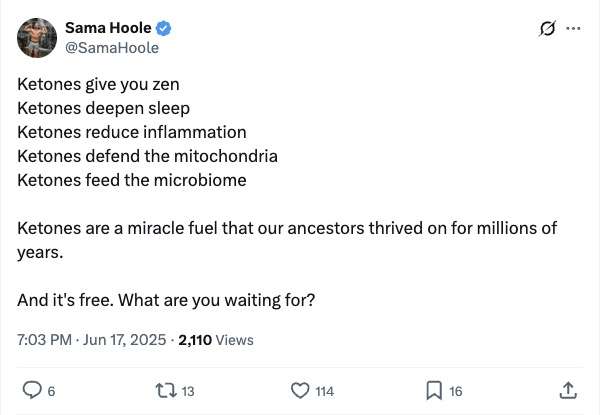
Nothing wrong with ketones. We produce them all the time ’cause we’re burning/recycling fat most of the time…they can be elevated through sustained energy restriction (starvation or CICO dieting) or through sufficient dietary fat intake (such as the epileptic diet).
But it’s a backup source of energy. Glucose is primary. That’s why our brains require about 120g daily. REQUIRE. That’s 30 tsp of sugar.
This romance narrative is like being so in love with your backup generator for your house, you just want to run it all the time, 24/7.
And it’s NOT “the way we evolved over millions of years.” That’s too false to even give the respect of a rebuttal.
Here’s a contrast. Phnom Penh, Cambodia, 1962.
Look at all the fat people who are eating hundreds of grams of starch (rice) and sugar (fruit) carbohydrates daily with corresponding very low fat and lowish protein (est about 10%).
And now, before we get into the nitty-gritty, the video I put up yesterday that delves primarily into how all these new revelations helped me, after 5 years, to finally gain insight into why Thais who eat traditional diets (rather than 7/11 and junk stands) are so damn lean and energetic on so much starch (rice) and sugar (fruit).
Weighing in on The Sugar Diet Craze
How It Works
In the simplest, most basic terms, protein restriction. If you Google around, the average protein intake for 1st world folks around the world seems to be around 16%. That’s admittedly a gross average. What I can say is that since the year of my birth (1961) to 2022, about 61 years, global protein consumption has increased one helluva lot.
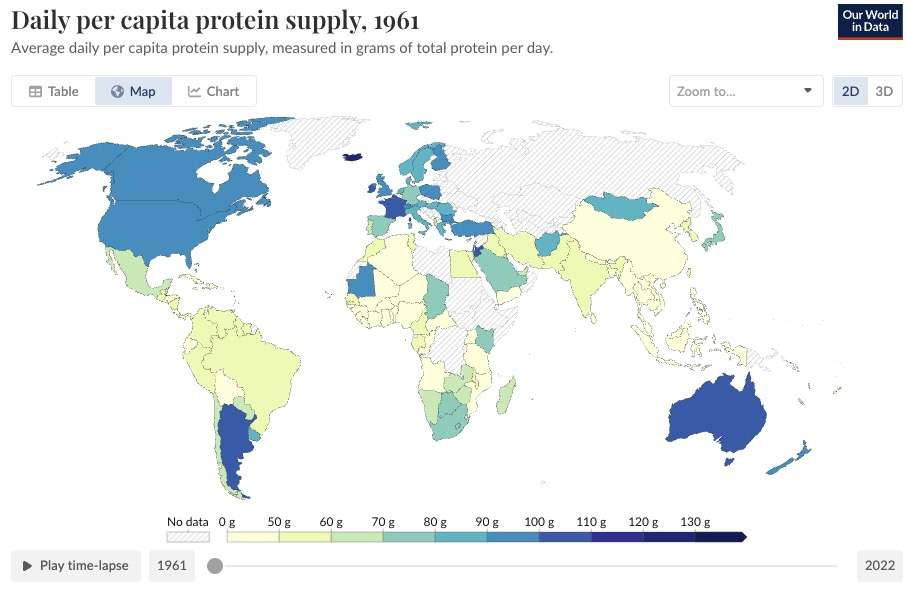
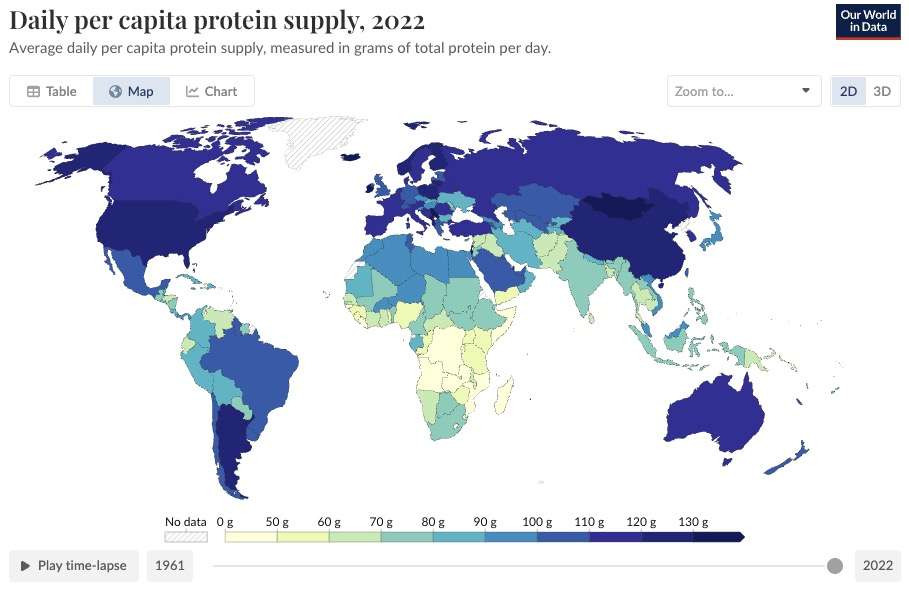
What has also increased? Obesity. So, it’s an association. That means it’s worth studying, hypothesis formulating, and testing. Warning: there will be many confounding variables. It won’t be “high protein causes X.” It will be, “many who eat high-protein also do X, Y, and Z, and those are the real problems.” That’s how association science should work. Almost never does.
What I aim to do, on a personal level, is find out for myself. Let’s just say that in the 18 years since I got into this in 2007, I didn’t have too much trouble taking off the initial 50 pounds or so, nor generally keeping it real since, using variations of LC Paleo and fasting mostly. But true leanness has always alluded me. Or, I should say, it was a diminishing returns scenario. It just wasn’t worth the PITA and obsession required.
But if it turns out to be as enjoyable as a Thai loves their traditional whole food (hint) and just as easy? Well, count me all in.
Anyway, here’s a good rundown on the science, and not from a fanboy of “The Sugar Diet.” He’s just honest enough to admit that it does indeed work, and for the same reason the Potato Hack works (though there’s a difference I’ll explain later). And surprise surprise; guess what? It also works similarly to the opposite sort of thing. The original ketogenic diet for diabetics where about 90% fat is consumed (to produce ketones from dietary and not ass fat), trace carbs, and the rest is protein, under 10%.
Nick has the same primary reservation as I did when I first heard of it: nutritional density. The same would apply to the keto diet at 90% fat (or even way less fat for that matter). Fat alone has nearly zero vitamins or minerals. This is easily verified. Plug in 100 grams of whatever isolated fat and bring up the nutrition chart. This is why I tend to think of isolated fat like most think of refined sugar. Empty calories, only fat is over 2x empty calories per gram.
SO, this is why my approach, to begin with, is to find a way to sustainably do this as a diet rather than a hack. For a diet, two ways. 1) a leaning diet, which should be relatively short term for most. 2) as a maintenance diet, long term. This requires sufficient nutrient density, i.e., vitamins and minerals. As for the Hack method, that’s no big deal because it’s a hack. A few days to maybe a few weeks. Hard to do damage in short bursts like that.
A Few thoughts right off the bat. For protein, make especially sure you’re getting it from animal sources (land, sea, inland water). Fat from eggs, not butter (or equivalent) for fuck’s sake. Maybe a little skim milk (the cream is, again, butter). For the carbs, use whole fruit, primarily, a variety, because fruit has vitamins and minerals (and fiber to feed the gut). Use coconut water for electrolytes. Limit fruit juices, sodas, and candy…enjoy in moderation. I have not delved much into starches (tubers, bread, rice, pasta, etc.). Potatoes have decent nutrition, and even complete protein, average about 5%. More to come on all of this as I experiment.
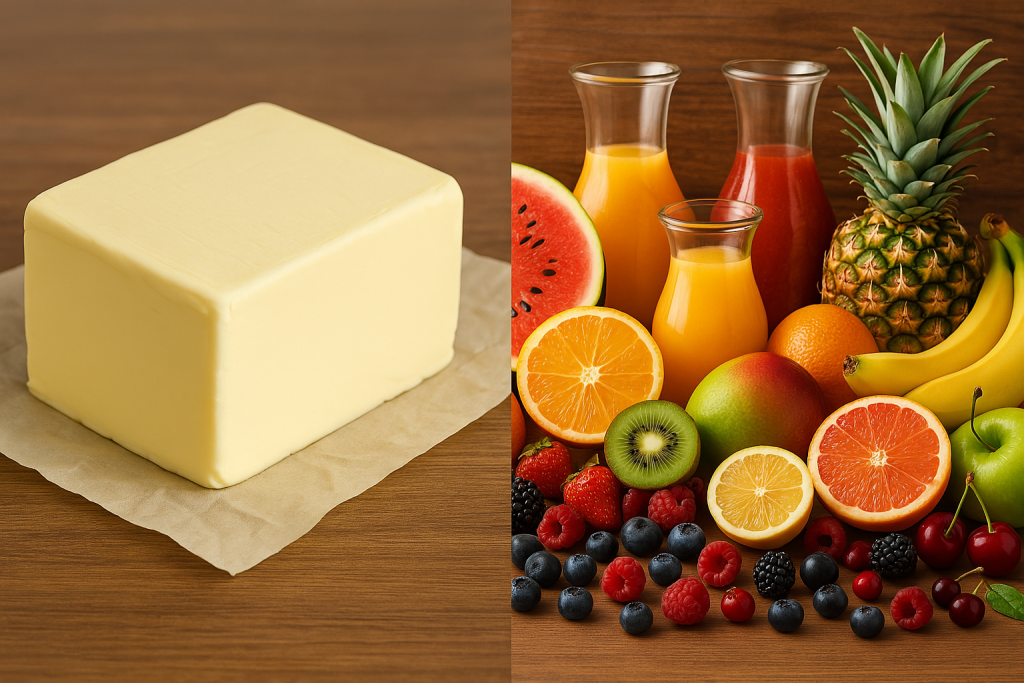
… Speaking of butter, time to reveal what that lead image is all about. I like Carnivore Dr. Shawn Baker. But he had to go and put up this stupid video.
So that’s the reason for the image. Shawn, fire your marketing department. Here’s how I framed that image when I posted it on X and FB.
Anyone see Dr. Shawn Baker’s takedown of “The Sugar Diet?” I put these in the “hack” category…i.e., a few days to a couple of weeks.
Looks like everyone pretty much agrees that with very low protein, there is activation that sheds fat quickly.
The rub is whether to go all fat (no protein/carbs) or all carbs (no protein/fat). BOTH will shed fat quickly.
THE OTHER rub, one almost always overlooked, is what about metabolism? The all-fat will slow metabolism, so fat loss will begin to slow after the initial stages of the hack. The all-carb will ramp up metabolism (400% in some mouse models, 20-30% in some human models) and the ramp up will continue, accelerating fat loss the deeper into the hack (many can’t keep up with the metabolism boost).
I’ve illustrated the two approaches. Dr. Shawn Baker’s on the left, the sugar-hackers on the right. The choice is yours…or neither.
Compared To The Potato Hack
Remember those days way back? Here’s a search link for lots of all of the many posts I put up about that. Knock yourselves out.
The PH works; almost everyone. It’s the one time in all the dietary hoopla that seemed to work for the most people most of the time. It wasn’t until a few days ago that I realized that there was a hidden reason it worked, too. See, we all knew that plain potatoes without fat on them (like fries, chips, or all the fixin’s on your bake) are crazy satiating. Few people reported that they could eat more than about 1,600 calories daily, so automatic caloric deficit for many, like 600-800 and more. One nagging issue, though, is that weight loss reports seemed to show loss over and above what you would calculate based upon 3,600 calories = 1 pound. Oh, well. I don’t think we ever figured that one out.
Now maybe we have the answer. The hormone Nick talks about in the sciency video above. So, even in a caloric deficit which should typically slow metabolism, maybe there’s activation that burns fat anyway and tosses it off as heat and extra moving around activity. Just a guess. Food for thought.
The glaring problem with the potato hack is that if you’re being honest, you probably hate and dread it. I could just never love it, as effective as it was. So, it was hard, not easy. That’s no excuse, I know, but it is what it is.
Here was my tropical fruit run just this afternoon.
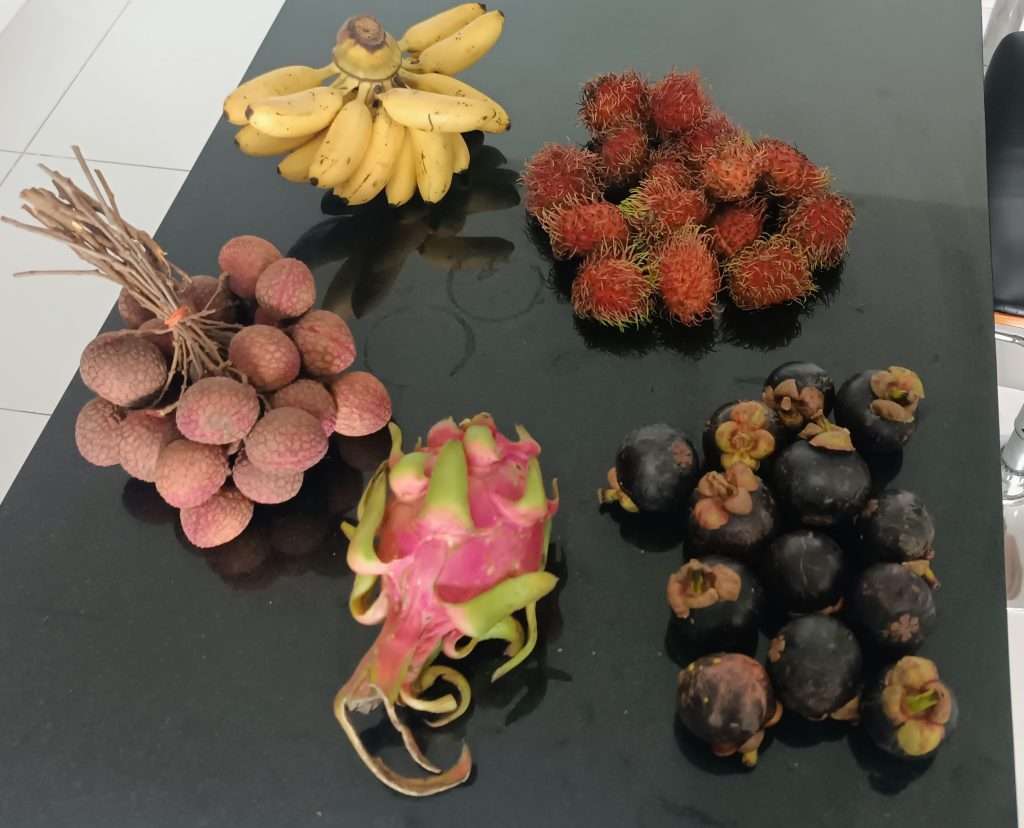
263 Thai baht. 8 bucks. I remember paying exactly 8 bucks for a single red-flesh dragon fruit (the one in the center) at an import market in the US in 2019.
So the apparent bottom line as I dive deeper and deeper is that with the fruit (and other sugars), it’s quite easy with the variety and delight, so you can eat significant calories and if you think that’s a problem, it’s not. The more you eat, the more it ramps up your metabolism. If you watched Nick’s video above, he shows that. Some mice models show increased metabolism of 400%. That’s mice. In humans, seems to be about 20-30% at least in the short term. How long it can keep ramping up, I’ve not dived that deep, yet. Anecdotally, it seems that in this process—we’re talking in terms of hack right now, carbs only for a time, mostly whole fruit—people taper off, so in addition to the hormones, you’re undereating in terms of your new, higher metabolism.
I’ve seen too many anecdotes of people who eat as much fruit and drink as much sugar water as they want and drop 30 pounds in a month. This also seems to spare lean tissue loss, but again, I need to dive more into that part. I have yet to see a negative testimonial from people who have actually tried it for sufficient time. Doesn’t mean they aren’t out there. It means I’ve never seen anything quite like it. There were plenty of negative testimonials about the potato hack.
LC, Keto, Carnivore
When I first began thinking about this, the first thing that came to mind is, it’s been 18 fucking years and this is still not settled. Back in 2007, it was basically only LC. Then 2012 comes along, then it’s all Keto all the time for years. Then, whenever it came around, sometime last few years I guess, now it’s all Carnivore.
In other words, this thing has to keep ramping up and doubling down. I begin to wonder if there are people out there wondering if there’s a way to have a negative carbohydrate intake.
The second thing I began thinking about is how this unnatural obsession with carbohydrate restriction must have negative overall metabolic impacts somewhere. There in no shortage at all of LCers who’ve been LCers for years and decades. Still fat. My guess is that chronic carbohydrate restriction slows metabolism over time, so caloric needs decrease, so the target moves toward you and suddenly, you’re gaining on the same intake that used to be maintenance. So if high protein or high fat raises metabolism, perhaps they’re washed out by the extent to which carbohydrate restriction decreases it.
Now think about that again. LC with the metabolic target moving toward you, eventually behind you, so you have to cut eating even more to get unstalled (“stalled” is the most commonly used word in all of LC dieting forever). Contrast that with this newfangled sugar diet, where you’re chasing the metabolic target and can’t keep up. Your base metabolic needs keep increasing instead of decreasing. Paradigm shift, and I’m gonna make a prediction about that.
It remains to be seen if the ramping up of metabolism on high carbohydrates (with low fat and lowish protein) produces better outcomes. There’s lots of stuff out there about this “sugar diet” rectifying insulin resistance brought on by the no-metabolic-excercise-ever LC and ZC dieting. There are even claims of T2 diabetes reversal. Ironic much? Stuff I will look into, in time.
My Guess: What Caused Obesity
Well, the meta-rule that applies everywhere is that money makes you fat. People in poor and poor-but-developing countries aren’t fat. They can’t afford it. I’ve often told the story that when I first arrived in Thailand 39 years ago, 1986, there was no fatnesss (much less obesity) I could see. At all. That persisted until my last of about a half-dozen trips and several months total in the country until the beginning of ’91. In 1985, the World Bank figures showed 85-90% of Thais below the poverty line. Fast-forward to 2020, and it was exactly the inverse. Now only about 10-15% are below the poverty line, and the progression was as linear as any line I’ve ever seen. Now there’s significant fatness. Think USA 60s and 70s. Plenty of fat people, very few obese, but I’ve never seen morbidly obese. And now, people can afford all the same shit Westerners can afford, dispensed and distributed by all the Usual Suspect International Cartels.
But that’s just the environment we live in now, not necessarily the cause, per se. What we’re looking for is what some people are doing in this age of abundance that other people do less or just have metabolic advantages…or they simply—for whatever reason—keep food intake low enough that it trumps everything else.
I’ve been harping on “oxidative priority” forever. Here’s the paper. Nobody is interested, ever. Not one single doc or PhD I’ve ever made aware of it. I asked Grok to give a high-school level explanation of oxidative priority.
Oxidative priority is a concept that explains how your body decides which nutrients from food to burn, store, or eliminate after you eat. Think of it like a to-do list for your metabolism, where certain nutrients get dealt with first based on how easily the body can store them. This idea comes from a 2017 study in Metabolic Syndrome and Related Disorders and helps us understand why some foods lead to fat gain more than others.
When you eat a meal, your body breaks it down into macronutrients: carbohydrates (sugars), proteins (amino acids), fats, and sometimes alcohol. Each has a different “priority” for being used or stored, depending on how much storage space the body has for them. Alcohol is handled first because the body can’t store it at all—it’s either burned for energy or turned into waste. Next come proteins, which have limited storage as amino acids, so they’re often used for energy or converted to heat. Carbohydrates are third; they can be stored as glycogen in your muscles and liver, but only in small amounts. Fats are last because the body can store them almost endlessly as body fat.
Here’s why this matters: when you eat a mix of these nutrients, the body burns them in this order (alcohol > protein > carbs > fats). If you eat a lot of carbs or protein, your body focuses on burning those first, which means dietary fats are more likely to be stored as body fat. Frequent meals keep you in this “fed” state, reducing fat burning. The study suggests that eating less often and choosing foods with lower energy density (like veggies) can help your body burn stored fat instead of storing more, which is better for weight control and health.
So obviously, frequent mixed meals with significant fat in them, and even washed down with alcohol, makes you accumulate fat over time. Because you can afford to eat as much as you want, as often as you want, returning to the meta-rule, money makes you fat.
Still, zero people will be interested. They never are. Not a single one, in many years.
Think of it this way. Did paleoman sit down to lavish mixed meals 3 times per day? Or, did they get a nice kill and basically eat it until it was finished? Or, they found some growing thing somewhere, like a bunch of fruit. What did they do? Gorge themselves on the fruit and only the fruit until no more pickings to be had. Etc.
LCers think they solve this dilemma by just eliminating the carbohydrates. For that strategy to work, you’ve got to eliminate the alcohol too, and severely restrict the protein (like the epileptic diet does).
… But if I had to guess and predict, I will say that the huge proliferation of junk and foods with both significant carbohydrates and fat in the same package is the chief driver of obesity. Toss in all the engineering that makes people crave the hell out of it, make it inexpensive enough they can afford it often (not a treat, a staple), and you have the making of a fat bomb that has been dropped on the whole modern world.
I’m not really talking about potato chips or the snack realm in general.
I’m talking about double and triple bacon cheeseburgers with Super Sized fries and Big-Gulp sugar drinks. I’m talking about 7-Layer burritos. I’m talking about Foot Long everything, dogs and subs (extra meat, cheese, and mayo). I’m talking about 2-for-1 extra large pizzas with fatty meat, and it’s not enough the 1/3″ of cheese all over, they gotta put it inside the crusty rind, too. I’m talking about the 16oz ribeye with the 1/2 pound baked potato sliced and spread so wide you can get 4 TBS of butter and 4 TBS of sour cream in it…and don’t forget the bacon bits and 3oz of shredded cheddar on top. Now that’s loaded. Oh, and that meal was preceded with a salad smothered in 500 calories of blue-cheese fat dressing and a couple of warm dinner rolls, smothered in butter. And everyone loves all this stuff, me included.
I could go on and on. I could talk about sugary pastries with butter melted on top. Or, how about a stack of pancakes with maple syrup, pretty low fat, until you put 2 tsp of butter between each cake in your super stack of 6.
These are all examples of the ridiculous blending of carbohydrates and fat. And it would be fine. And it is fine, same as Thanksgiving and Christmas dinners. Or, hell, nice Sunday dinners.
And that’s kinda how it used to be. We had a sense that this kind of eating was for rare and infrequent sorts of things—and it was never a problem that way. And in the old days, like up to the 80s and 90s, money was an object. Now, hell, most can indulge that way almost every day.
And that accumulates fat. You can afford it.
My prediction: Due to the sheer weight of positive anecdotes and many people publicly abandoning all forms of LC in favor of this poorly named or brilliantly named “Sugar Diet,” put a fork in LC over the years to come. At least as in any influential way. How long can you utterly fail, while continually doubling down and moving goal posts, before people have had enough already?
… So with that, I’ll close. From here out, it’s going to be a lot of self-reporting. I’m at the end of day 3 on this (as a sustainable diet, not a hack…which I plan to do once the girl heads back up to the familial home in northern Thailand in 5 days).
I’ll keep you in total suspense as to how it’s going so far.
WHAT IT'S ABOUT AND HOW IT WORKS
Free The Animal is an eclectic writing project about everything since November 2003. 23 years, 5,500 posts, 5 million words.
It's a paid membership blog. Most posts are free and public, but only paid members can comment. What determines whether it's free or paid is when I publish. Monday through Friday, free and public. Saturday and Sunday, for paid members. That's it. Membership info here.
Great stuff, Richard. I’ve been a pretty strict carnivore for a number of years — and wondering why I remain 20 pounds heavier than I want to be, even though caloric tracking says I’m at a deficit. I’ll give this sugar diet a fair shot along with you and report back.
This is fascinating and I can’t wait for future posts. Understanding that you’re just starting this, I’m curious to see if you’ll get into the effects on your blood sugar/glucose/insulin/triglycerides (fructose from all the fruit)/etc., separate from the effects on weight loss. That is, if you’re even interested.
The way you were tending to eat – is just like the food separation diet that Don Lemmon was promoting in the late 90’s and early 2000’s before he died in a car accident- I did that for a while and felt amazing ! It’s easy to fall off of it. If you look around hard enough you can find his book to read online (Don Lemmon Know How) He’s from a bodybuilding background so his diet is 6 meals per day which I think is nonsense. Separating the foods out and avoiding mixed meals is definitely a key. I think that the food separation thing is going to be popular again.
Thanks for the clarity on this subject ! Was hoping that you would share sooner than later 😊
Was looking around on line and was getting a bit weary of some of the nonsense.
Always down for a new hack or if makes my belly feel less painful more the better.
Great post, Richard. This reminds me of Ray Peat’s work on sugar and his version of a pro-metabolic diet. He believed:
• Glucose is the preferred fuel of most cells.
• Sucrose from fruits, honey, and dairy promotes better metabolism than starches or processed grains.
• Sugar, when properly metabolized, lowers stress hormones and supports thyroid function.
• Avoiding PUFA (polyunsaturated fatty acids) is just as important as consuming sugar, as PUFA suppress metabolic rate and promote inflammation.
He often cited the likes of Hans Selye and his pioneering work on stress physiology and Broda Barnes’ emphasis on thyroid, basal temperature, and pulse rate as markers of metabolic health.
Alex. Yea, while I never followed Ray directly, I was made aware of all his ideas over time through others who did follow him. I’ve even tried the salted and caffeinated ice cream before bed (if I recall correctly). Works. I like my OJ with the pulp, though. ;)
Anyway, on day 1 of this, in the evening, I was hungry but had no more fruit or juice, so I grabbed two slices of whole wheat bread and ate them plain. 30 minutes later I have a crash and can’t keep my eyes open (this is about 8pm). Resolved after about another 30 minutes. Fruit and juice NEVER do that, provided consumed in isolation.
I think it’s because bread is really a UPF.
Thanks all. I’m going to respond only to comments where I have something meaningful to say. But I read every comment.
Do you plan to drink alcohol during this experiment?
I haven’t so far, but making no promises. ;)
Great stuff, Richard!
I am looking forward reading more about your approach to the “sugar diet”. After being a long time LC-advocate, I made the switch to a lot more fruits this spring (mainly only fruit until noon) and have realized quite a lot of stubborn belly fat loss. I haven’t made the switch all in so far, but consider testing it out.
How firm was the evidence that our species evolved on a largely carnivorous diet? For years, we’ve been told that anthropological and biochemical findings all support the thesis that meat+fire is what catapulted homo sapiens out of the bonobo tree, that sweet things were a rare seasonal treat, that vegetables were inedible before Mendelian cross-breeding, that agriculture was a huge mistake that weakened everyone? This was all chapter-and-verse for me because it seemed logical and irrefutable. It also made veganism seem like a reality-denying cult.
So now the reverse is true? High carb/low fat/low protein gets the nutritional gold ring? Was the research done by the paleo and ancestral folks ignoring or downplaying important contradictory data? Is there a genetic “best” diet depending on where your ancestors came from?
I’m trying the sugar-diet thing because I like to experiment on myself, but I have to admit it feels we’re on a merry-go-round.
I did the potato diet and lost a significant amount of weight. Around 16 pounds over 3 months, before quitting. During that diet I supplemented eggs and oranges for extra nutrients. I was boiling/poaching my eggs, so no extra fat. Salted for taste. I dont remember my alcohol consumption at that time. I definitely lost strength in the weight room, which I assumed lost muscle from not eating enough protein. But maybe just from not working out….I cut that out too, due to thinking it would increase muscle catabolism (combined with the low protein intake)
Sure. That’s why all these low protein things should be hacks, not diets and no long term. I don’t think its a big to lose a little lean over the space of a month. You can cycle it.