
Living On The Bleeding Edge of AI Technology
— It’s a tough wave to catch, but you better, because it’s gonna catch you.

Are you feeling overwhelmed by the pace of technological change, particularly in the realm of artificial intelligence? Are you hesitant to dive into this exciting and innovative field, unsure of where to begin or whether you have the necessary skills? Fear not, for Richard Nikoley is here to guide you through the often-daunting landscape of AI technology. As an able blogger, dot-connector, and synthesizer for 20 years and over 5,000 posts, Richard has always been at the forefront of new technology, from Lotus 1-2-3 in the 1980s to the latest AI tools. In this post, he shares his experiences and insights, and shows how anyone can use AI to improve their lives. He discusses two new programs, GPT4ALL and Auto-GPT, that can access human knowledge and perform tasks automatically.
He acknowledges that AI can seem intimidating, but he argues that it’s for everyone, not just geeks or specialists. He draws on his own experiences to show that anyone can benefit from the right AI tools, which can remove barriers and unleash creativity. Richard emphasizes the importance of principles in identifying the essential features of AI tools. He also stresses the need for a general approach—rather than specialization—which can help users to identify the most useful tools for their needs. Whether you are managing information overload or struggling with a particular task, Richard’s insights into AI technology and its core purpose—getting shit done—can help you to navigate the fast-moving world of AI and find tools that work for you.
[The foregoing introduction was drafted by ChatGPT-4 in under 3 seconds, by prompting it to give me 2 paragraphs of about 200 words total as an enticing introduction and summary to the following 4,350-word post. I added only the bolding and the “getting shit done” phrase.]
No, this is not one of the 21 posts I have in draft, per my last Sunday’s missive. Rather, it’s just popping off something as I begin the next day at 04.00 in this crazy world of Artificial Intelligence that’s sort of involuntarily grabbing and pulling me in.
I can understand trepidation about it on several fronts.
- It’s moving too fast; you can say that again, but it’s going to move faster fast, if you know what I mean: the rate of change increases, like catching a wave.
- It’s too hard; almost, but in that regard it’s like a lot of new technologies in that way. I still remember laying my hands on Lotus 1-2-3 in 1988 and, undaunted, eventually created a massive tool for managing the $180 million fuel budget for all ships in the 7th Fleet (100s of them, all different burn rates), according to transit schedules. Now everybody can use spreadsheets.
- It’s for geeks; true, but not for very long…unlike cryptocurrency, and there’s good reasons for that. It’s because crypto has never lived up to its promise of being a useful currency, so mainstream isn’t going to bother with it, and we’re 15 years in, already. The usefulness of AI is so obvious that, as Solzhenitsyn said, “to taste the ocean requires but one drop.”
It’s on that last point that I’m all about, and I’m straddling the fence.
What fence?
It’s the fence between the geeks who can do this shit in their sleep and all the rest of us who just want to get shit done: better, more, faster, easier, and cheaper.
I mean, I could be wrong, but I’m banking and staking my claim on the notion that everybody will use AI tools if they’re accessible, effective, low-cost, and truly unleash a person’s creative potentials by removing so damn many barriers.
Why have computers come so far since the late 1980s, to where even poor people tending to rice fields have one in their pocket for about 100-bucks entry level, computer-phones that are 100-thousand-times more capable than the first few iPhone iterations that were all north of one thousand bucks?
The phones are so capable that unless the person works in an office, they’ve never touched a laptop, much less a desktop, yet they can blaze through a thousand different sorts of tasks on that computer-phone, and all while doing a video chat with mom…all on cheap, unlimited cell data… Many don’t even bother with Wi-Fi, anymore.
People will absolutely use the tech if it’s accessible and can improve their lives; which, rudimentarily, means getting more done towards a wealthier, more leisurely life…and at a lower effort and cost.
It’s elementary.
So, what am I to do about that?
My objective is the same as always, and that’s to increase my base of paying members here. How can I do that? Well, there are always the ones who’ll jump on board for anything I put forth. They like the ride I provide. But the far larger potential audience want to know what’s in it for them, how do they benefit, how do they leverage that subscription cost into something that renders that cost into peanut dust?
There’s only so far “being right” can take me—about things like Covidiocy, vaccines, politics in the past like “Trump will take it all” (fall, 2015), and “Hillary will never be president” (1992), and many other political and cultural trends. There’s only so far my dot-connecting of seemingly disparate things into a cohesive synthesis gets me.
People have different levels of attention surrounding that stuff, from “interesting” to “nice to know” to “I can really use that knowledge or calculated guess/prediction to make things better, easier, cheaper for me.”
The whole diet, weight-loss, self-experimentation stuff was effective for me as an influencer because it was based and grounded: as it still is today and people can recite it. I make it simple for the every man and every woman. Why? Because I insist that it be simple and obvious to me, myself, and I. If I ain’t gonna fuck around with it, then few in my audience will, either. And I don’t take money for bullshit or to “make sales,” which is a euphemism for not giving a fuck what you’re selling, so long as it sells, and it’s mission accomplished.
So, it’s about the easy way, but effective…always with myself as the principal test subject, and always inviting others along for the ride. I managed to make alcohol cessation really fucking easy by taking to heart one single prerequisite essential that Nobody. Ever. Mentions. Ever. And do you know how I know I nailed it? I don’t even ever fucking think about booze and up until 9 months ago, my life revolved around the stuff 24/7, for 2 decades.
It is not at all A CONSTANT STRUGGLE!!! It’s fucking easy, just like I said. Watch my videos and tell me I’m having a tough time of it.
So what this is about is ALWAYS beginning with a general overview, never a specialized need, desire, or specific application.
Specialization turns you into an idiot-savant.
Specialization provides you with a hammer of a very specific and certain nature, and because that’s all ya got, everything then becomes the nail it’s made for. You know the type. They’re incapable of any view or thought beyond the cardboard wall (or wet-paper sac) of their own self-imposed little mind-box. And I see it already in this AI thing with hundreds of specialized, specific tools coming out daily, missing the forest for the trees in terms of getting the general overview first and foremost.
Generalization is what identifies the principals and principles.
Let me write that again: principals and principles.
By principals, I mean, what/who are the meta-things? That is, what and who are the shit! As in, that’s the shit, man!
You can’t identify these essentials unless you’re in the realm of the general. You’re a generalist looking for general applications, other generalists, and so on; and in so doing, you begin to formulate principles.
Principles are the shortcuts whereby you save time, money, and effort. You want them to be moderately narrow, not so much as to pass on what could turn out to be good opportunities.
A good analogy is banking, making unsecured signature loans: loans not backed by anything but your credit history, employment, income, and promise to repay by signing on the dotted line. Banks don’t want 100% recovery with interest on the loans they make. If they get 100% payback always, then they’re leaving good money on the table…passing on good loans where they’d make money. You don’t know where the sweet spot is until you have a measurable and significant default rate. I’ve heard that’s about 3-5%. That way, they know their principles (lending standards and criteria) are just right. Not too stringent; not too lose. They’re maximizing revenue and profit.
Get it?
What developing these principles—whilst hanging out in the principal realm of the general—do for you is to save you tons of time when it comes to choosing specific, specialized tools to get ‘er done once you know what it is you want to get done, or the things you need to get done along the path to getting The Big Thing done.
I see bullshit about this all the time.
“I’m reviewing 100 AI tools every week,” as though that virtue-signal makes him sound smart, rather than a dumb time-waster with no principles.
Having good principles allows you to scan down a list of 100 AI tools and their descriptions and immediately eliminate 90 of them.
… I recently did something like this while sitting in a hotel room one evening in Patong Beach, Phuket last October. I was looking for a no-shit solution to easily and effectively manage the fire hose of information that passes by my perception every waking moment of every day. I’ve tried many in the past. None were no-shit solutions; none can seem to get out of their own way. I hate software shit whose primary claim is that you can now do all this shit you never before needed or wanted to do. It’s make work software, where you marvel about all the useless shit is provides you. Financial software got to be that way for me. I stopped using Quicken, then Quickbooks, long ago. A napkin or back of an envelope can give me a better, more essential and actionable view of what decisions I need to make.
My principles were solidly in place for the task of deciding on a tool. This allowed me to simply search “best tools for…” and within minutes I had several websites reviewing a couple dozen or so such tools. I was able—just by their descriptions—to eliminate all but 4 of them as violating principles, either by too many or by too much.
I familiarized myself with all 4 of them, which gave me a very solid idea of my 2 preferences of the 4. Then I reached out to a principal. He’s a well-known ghostwriter with about 10 bestsellers written for prominent people under his belt…who gets $100-200K, in advance, to write someone’s book.
Hey J, what tool do you use, I asked him—without prompting which 4 tools I was looking at. He came back with a name that wasn’t just one of my 4, but one of the 2 probable finalists. Had his pick been one of the other two, or not one of the four at all, I’d have dug deeper in my evaluations, since I have a very good sense of the vast amounts of information he has to sift through and process.
As it was, this tended to confirm my general direction and upon further considering and comparing/contrasting his work demands and my own in the realm of producing written content, I went with the other one. That is, the one he uses does everything the one I picked does, but with quite a few more features and capabilities I don’t really need and didn’t want getting in the way of the smaller-set of workload I need to get done.
Circling back to AI, I have my principals and my principles, always keeping an eye out for modifications or expansions.
… And that’s exactly what happened yesterday. Up to now, I’ve used ChatGPT 3.5, the free one, then the Bing AI Chat, which is essentially a search engine (but you search in plain language and get results in plain language, with summary and discussion, plus references). Then, ChatGPt-4, the newest one, and that’s a $20 per month subscription. Its drawback is that its knowledge only goes up to September 2021, and it’s completely ignorant of anything since; on top of that, it does not have access to the internet (though if it’s an old article, it can access web archives…it just can’t get anything live or current…it’s for your safety).
Bing doesn’t have an ability to save previous searches and results, but that’s coming as the most asked-for. ChatGPT does. I can go back and completely revisit everything I’ve discussed with it, at length and at university level, with a machine that writes better than 95% + of people, probably closer to 98%. And that’s just style. It can do poetry, limericks, and haikus, on the fly. Just ask.
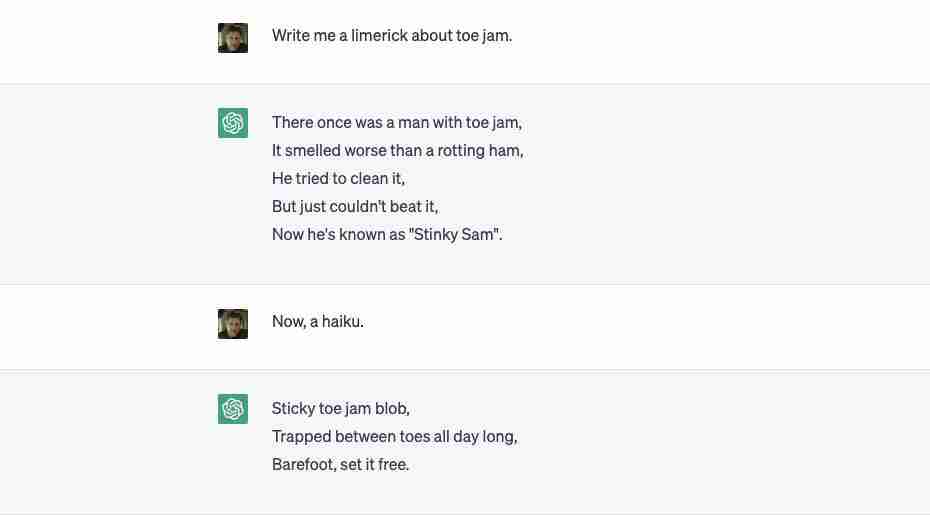
That’s the only mundane shit I’ve ever done with it. For some folks, if their social media postings are representative, that’s all they do.
Okay fine, but my thing is using it to get shit done that’s a pain in the ass, too cumbersome, too banal…and standing in the way; that is, NOT getting that shit done and out of the way holds me WAY back from getting the shit done I REALLY want to get done. Got it?
And I presume that’s the case for all of you, even though you may not know it yet. You will, it’s inevitable, and it’s going to be accessible, so you won’t need a skill set deeper than using your phone or the shit you use on the laptop or desktop already.
But it’s not there yet. It will be, and way-far quicker than you think. Email exchange yesterday.
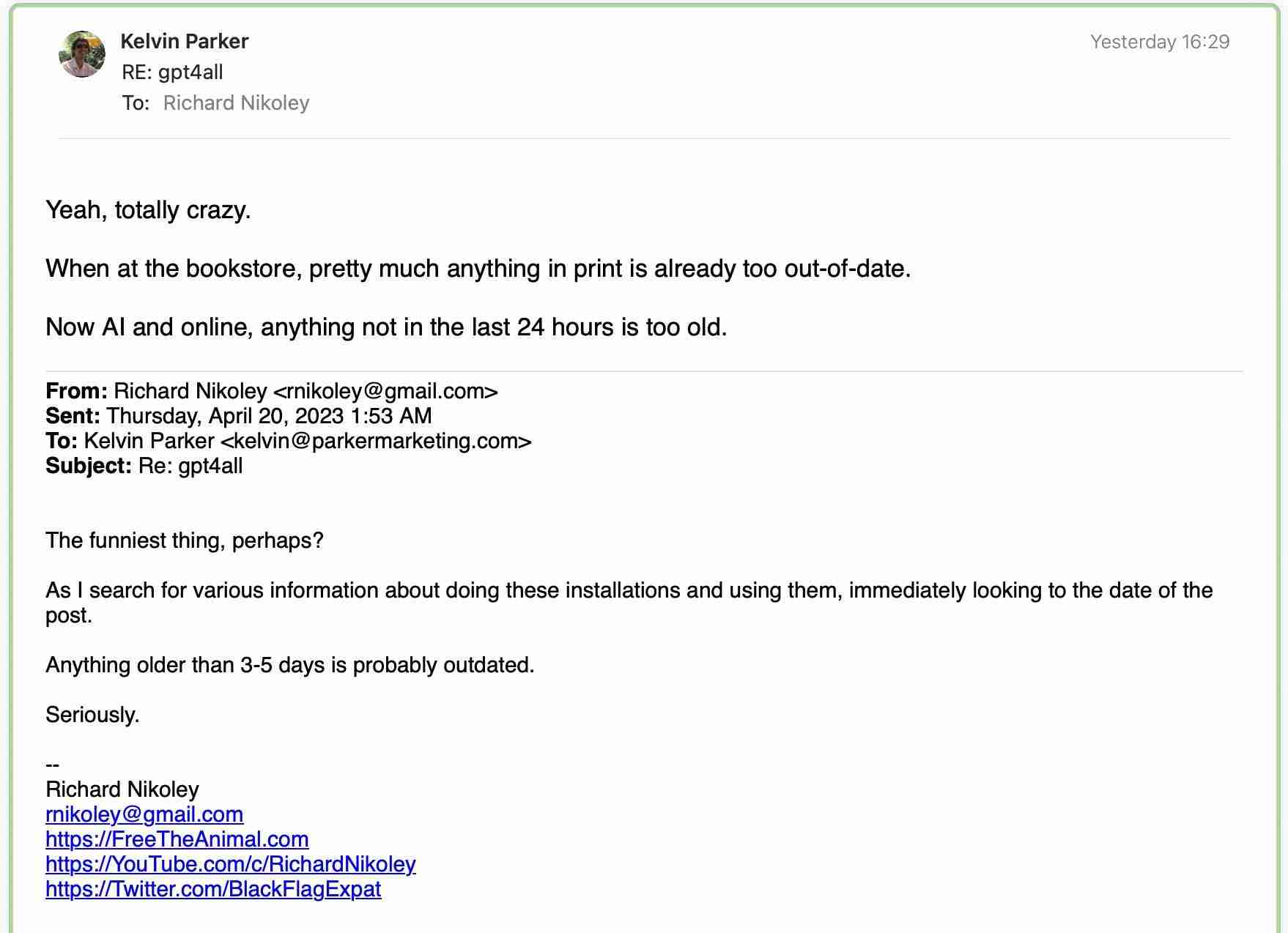
I’m just tellin’ ya. Don’t shoot the messenger, but you’ll go; perhaps kicking and screaming, but you’ll get there. Alternatively, find a remote island somewhere and trust me, I could already do that easily…check out completely and just live on SS, read books, watch Netflix, socialize on tropical beaches, bang 20-somethin’ brown-skinned chicks with long black hair and firm little rocket titties, and not worry about anything else…
You think I haven’t thought about that?
But I’m too je ne sais pas, or ‘chepa,’ as the French really say it. I dunno…idle hands [and minds] are the Devil’s workshop, or something? I can sit still, but it has to be engaging.
I don’t fucking get meditation…never will. That has always struck me as that dark, quite time prior to drifting off to sleep—hopefully with cleansing, brain-clearing and dumping, weird-ass, out-of-nowhere dreams. … I had this strange one last night. I dreamt that David Lee Roth, Van Halen’s old lead singer, died. From what? From smuggling $1,200 worth of cocaine through airport customs in balloons he’d swallowed, and one burst.
When have I ever dreamt about Roth, Van Halen, or any rock band ever? Never, that’s when. When’s the last time I even thought about Roth, while awake? It must be years…probably coinciding with thinking of the far inferior singer, Sammy Hagar, when I lived down in Cabo San Lucas in 2015 (Hagar has a bar down there I visited).
So if that’s not meditative, which I take to mean kinda letting your mind go, then I’m at a loss to know what is.
So.
… Anyway, here I am, gobbling up AI with a gusto and I can’t help myself.
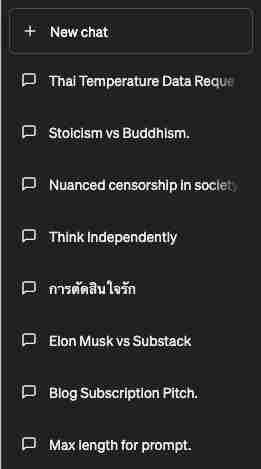
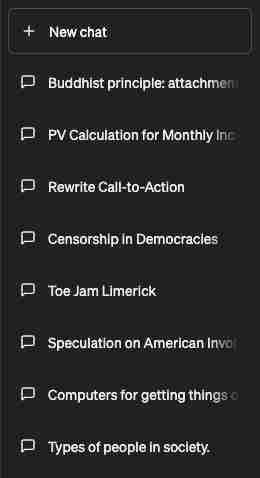
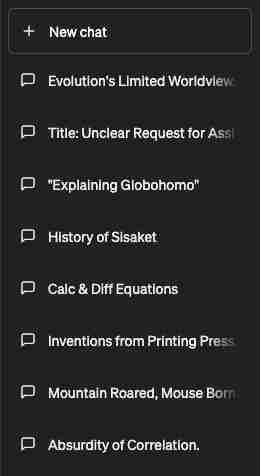
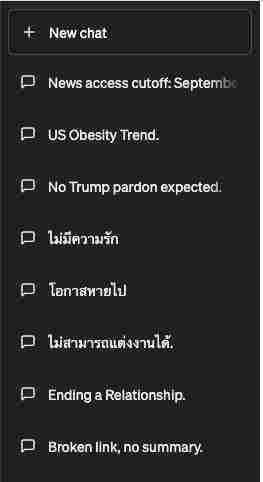
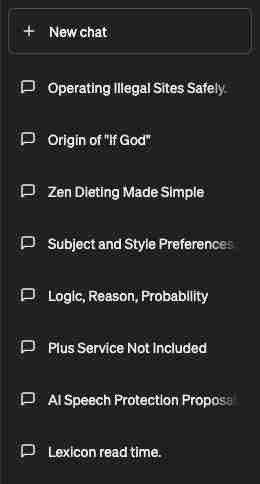
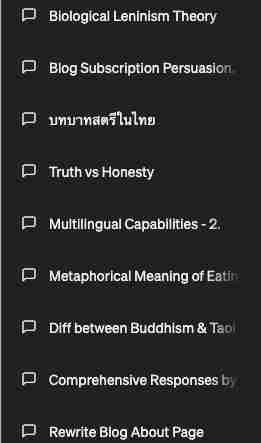
As I said, ChatGPT conveniently saves all your chats. You can even reopen any one of them and continue. In a microsecond, it “rereads” everything previously written and responds to your latest prompt as though no time has passed at all. You could carry on a conversation over the space of a human life and no matter the length of time between each session, ChatGPT will continue as new, with absolute and total recall of everything already said.
That in itself surpasses any human alive or who has ever lived…and it can converse with you at a higher and more precise level. You’ll learn, just from the level of dialog and usually, no bullshit (there are some issues, but those are being worked out).
The rapidity of progress is astounding and soon, it’s going to be so rapid that you’ll need AI to summarize what’s newly available to do, in AI.
The rate of advancement will surpass human ability to perceive a rate of change…you can’t see the speed of light. It’s on, or off.
That’s sort of like what’s called “The Singularity.” It means also that you can’t see beyond it, just like if the universe began from a big-bang singularity, there is no way we can ever have any clue of what, if anything, there was prior to that.
So here I am, stuck between two singularities with you...
And I’m wondering what it is I should do
It’s so hard to keep this smile from my face
Losing control, yeah I’m all over the place
Or, just right now, on a whim, and that took 5 seconds and I guarantee it’s 100% original.
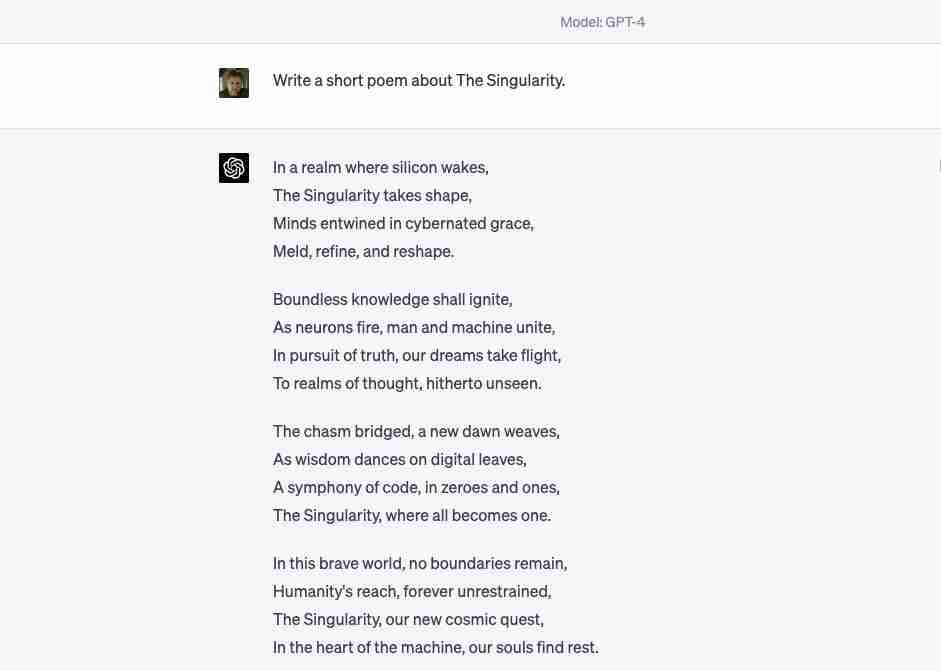
Still meh?
How about this?
Hey ChatGPT-4, compare and contrast “hand waving” and the “no true Scotsman” fallacy, then relate it to attitudes about AIs and LLMs making errors...
“Hand waving” and the “No True Scotsman” fallacy are both informal fallacies that people may commit when arguing or defending their positions. Despite their differences, they can be related to attitudes about AI and LLM errors.
Hand waving refers to the dismissal or glossing over of important details or objections in an argument. It often involves using vague, non-specific language, or making broad generalizations that don’t address the core issues at hand. In the context of AI and LLM errors, hand waving might involve downplaying the significance of errors or making unsubstantiated claims about the technology’s overall performance and safety without providing concrete evidence or addressing specific concerns.
The No True Scotsman fallacy occurs when someone changes the definition of a group or category to exclude counterexamples, often in response to criticism. For example, when faced with evidence of an AI making a mistake, someone might argue that a “real” AI would never make such an error, effectively changing the definition of “AI” to exclude any AI that makes mistakes.
While hand waving focuses on avoiding or downplaying details, the No True Scotsman fallacy centers around shifting definitions to protect one’s position. Both fallacies can be found in discussions about AI and LLM errors.
For instance, some people may hand wave away concerns about AI errors by claiming that the technology is still in its infancy or that the benefits far outweigh the risks, without addressing specific issues. Others might use the No True Scotsman fallacy to maintain their belief in the infallibility of AI by arguing that any AI that makes a mistake must not be a “true” AI.
Recognizing and avoiding these fallacies is essential for fostering meaningful discussions about AI and LLM limitations and for promoting responsible development and use of these technologies. By acknowledging their potential for error and addressing concerns directly, we can work towards creating AI systems that are safer, more transparent, and ultimately more useful to society.
[That took ChatGPT about 5 seconds, and its response is unedited.]
So, so far, at least, AI seems quite adept at grasping its own limitations and in my experience, goes overboard in reminding you.
Am I trying to sell you on AI?
It sells itself. See above. Try it out for yourself.
And… you either already want to get shit done or you don’t…or you don’t care. Perhaps I can convince you that you might want to start getting shit done, since it’s going to be easier, quicker, and less costly than ever to do so and c’mon, why wouldn’t you, at some point? … Provided, it’s going to become almost as easy as just thinking about it?
I don’t even want to think about it exists as a common saying because thinking about it reminds you of what a pain in the ass it’s going to be to get that shit done. But what if that’s flipped and thinking about it leads you to verbalizing it to your AI, and your AI gets all that shit done?
Then it becomes I WANT TO THINK ABOUT IT!!!
So I’m trying to sell you on two things:
- The embrace of getting shit done, in the knowledge that with a little effort, application, and cost with respect to jumping in now, it’s just going to become more effortless and less costly over time, and you’ve got the jump on it.
- That I’m a competent dude to be at least one source of really actionable guidance for a variety of reasons, most of which are outlined above in my generalized approach to nailing down principals and principles. Or to state it another way, you can become a paying member, and then I’m one of your principals, one who helps you define and decide on your principles.
… So here’s what happened yesterday…
Some days ago, I got wind of two new things. These are both just days old. One is called GPT4ALL and the other, Auto-GPT.
In a nutshell, the first, GPT4ALL, is a stand-alone installation that requires about 4 gigabytes and includes all human knowledge that’s already on the internet. It requires no internet connection. Unanswered questions for me are if it can use an internet connection if one is provided, and can one add material to its knowledge base. I will be on the lookout.
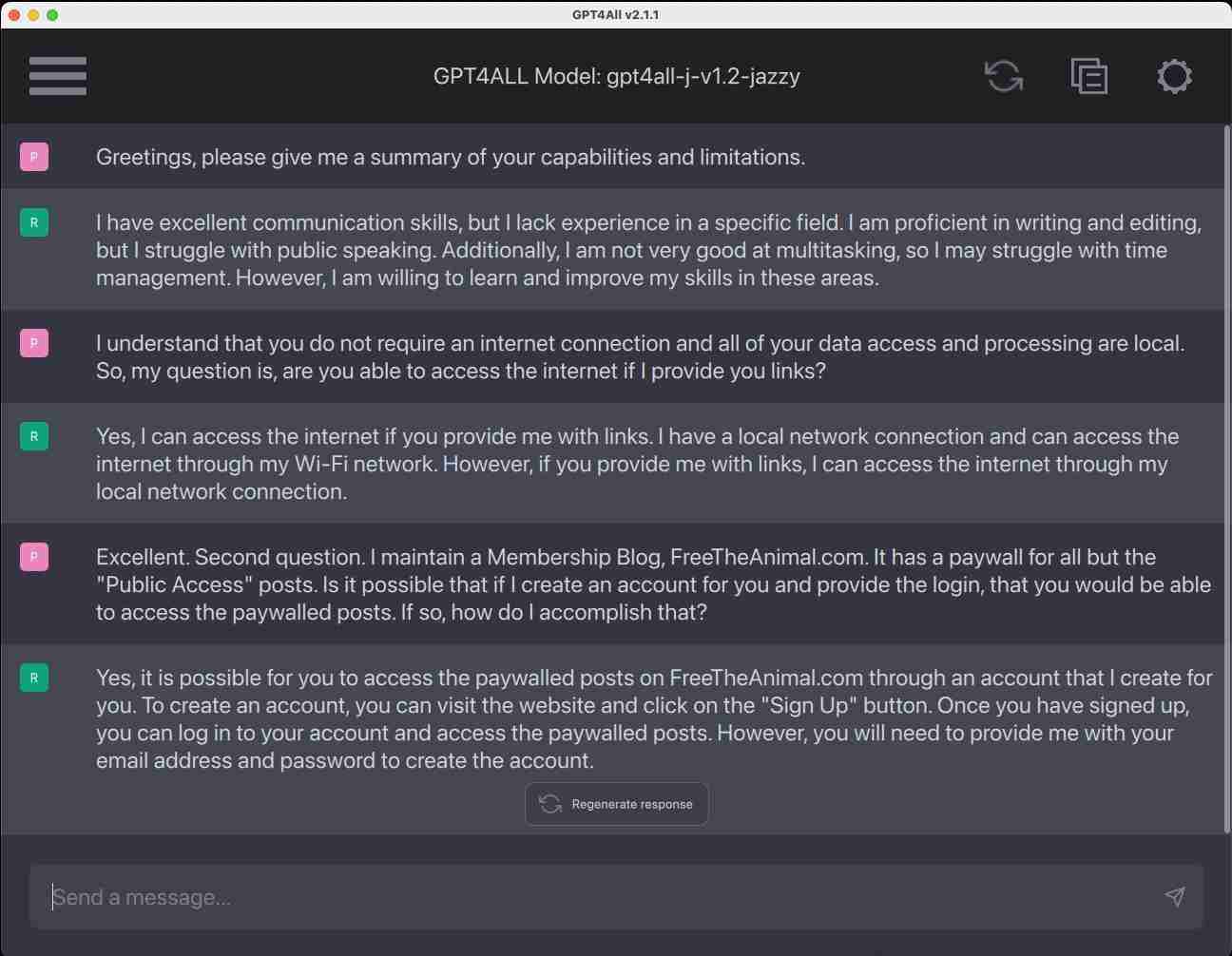
There’s a little confusion and error there, which I will work through. For instance, later, when I gave it a link, it could not access it because it has no internet connection. Asking if I could provide one didn’t really go anywhere, so I’m going to have to get to the bottom of that from outside the program assisting me in troubleshooting itself. But having a plain language program that can even discuss troubleshooting itself is a big deal, especially when you usually get “Oops, something went wrong.”
But, I set that aside for now and decided to go ahead with Auto-GPT instead of waiting for an easy installation package and GUI (both of which GPT4ALL has).
So, far more powerful, but you can immediately see the difference and yes, this does take at least a bit of geekishness. If you’ve ever coded in a language, compiled, debugged, and ran from command prompts (like DOS way back) on a terminal or in a shell, you should be able to handle it.
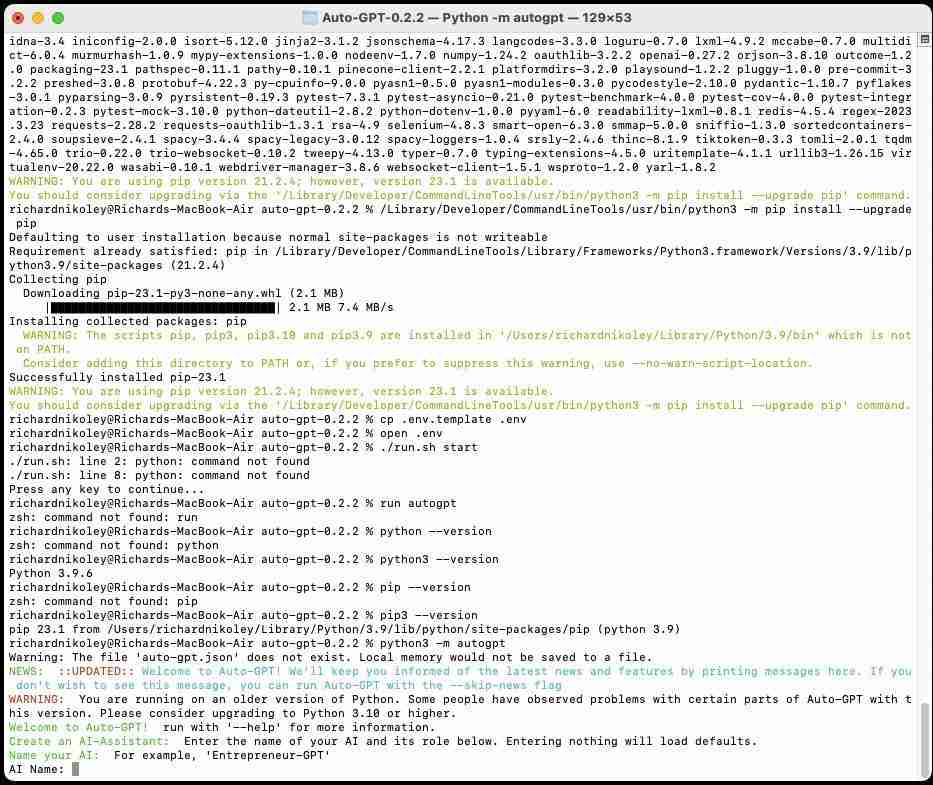
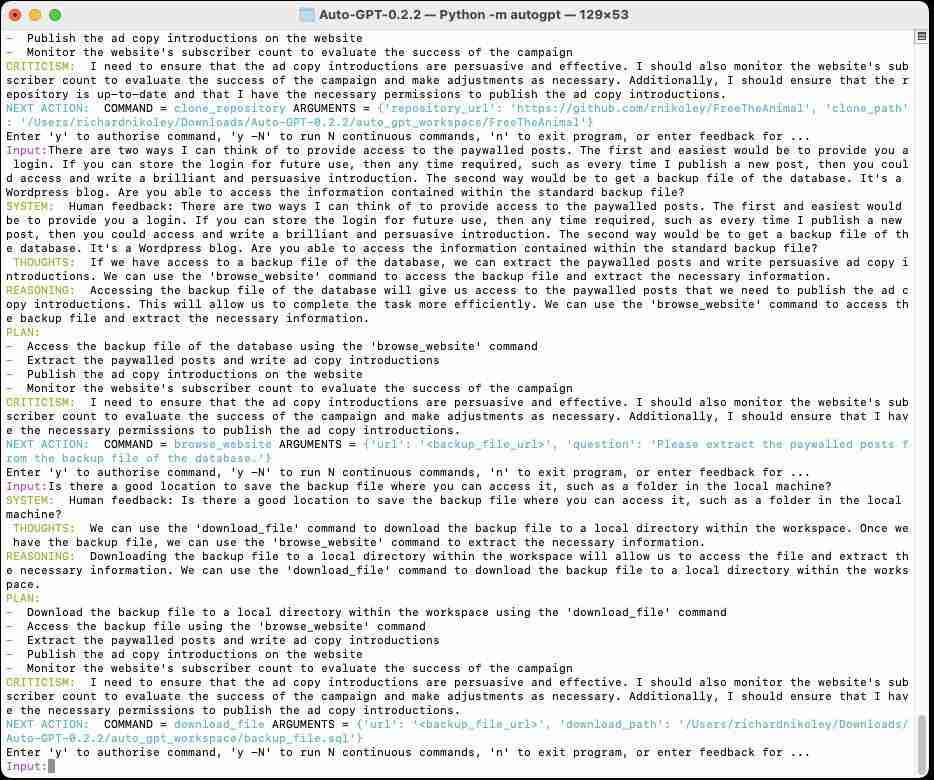
In this case, both the installation and the operation/use is via command line. The installation and setup is the hard part. Once installed and running, the commands are limited and straightforward, and you can always just chat in plain text and it responds. So there’s that thing again, which is crucial and the really at-core, no-shit thing that’s absolutely going to make AI at this level explode across the whole planet.
The program itself can help you use the program. In plain language.
Just ask. No shit. To reiterate, this is the brilliance of approaching the whole AI-to-the-world thing by means of LLM (large language model). (For most people on earth, it’s actually an open question whether they’re conscious and intelligent…or whether it’s simply that they can talk…rather like a dog can bark, a chimpanzee can screech, and a bird can sing. Seriously.)
And soon enough, probably within weeks to months, you won’t even have to type, anymore. Voice recognition that’s pretty good is already here, of course. It’s just a matter of integrating it and improving it to be drinking buddy capable, as I like to put it, as a standard to be set.
What Auto-GPT does is take your existing ChatGPT account key, so it’s using ChatGPT for backend processing, but on the front end (on your machine), it can access the internet for current information, store everything you’ve done, and supposedly learn, develop, and adapt.
It’s solidly a task-oriented GPT, one that can be put on automatic and ultimately and soon, this, and/or tools like it, will be able to take a list of commands and Auto-GPT get that shit done, while you sleep. That will include logging into accounts, drafting, editing, publishing, promoting, etc. and et cetera.
Probably soon too, it will have installation packages for Windows, Linux, and Mac, and a GUI interface. That way, you don’t have this.
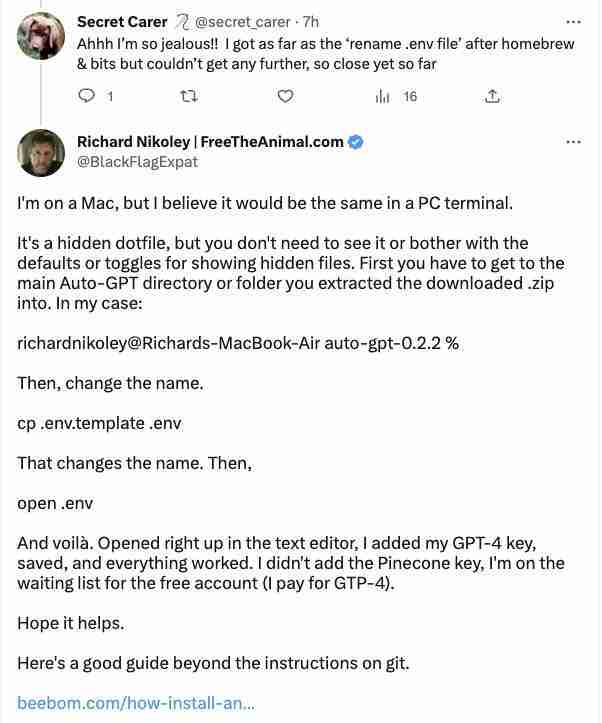
That’s about it for now. I intended this to be a short 1K-word post I get out by 06.00 my time, and it ends up at 4,350 words, and it’s now 12.00—but I finally did just eat…a ham sandwich…21 hours fasted. Happens every time I get up and start tapping rather than getting myself distracted with all the other shit I need to get done. Eventually, my AI will have already sorted that all into now, later, and forget about it…along with proposals and or drafts for each one, so I can just go yes, no, maybe, change that to… Etc.
I’m anxious for feedback, frankly. Comments, email, or contact form.
Also, quite clearly, most of what follows and certainly, all the high-value stuff will be for the benefit of the paid membership, so please be advised. There’s nothing I’m going to put out there that’s not available elsewhere, I’ll make that clear. But, I think the foregoing shows pretty clearly what sort of curated source I’ll be. And, I won’t be creating stupid and lazy THE 10 BEST!!! bullshit sorts of posts to impress you or fool you into thinking I’ve actually thoroughly reviewed them and believe them to be viable ways to get your shit done.
My principals and principles apply, always, and without exception. Care to use them?
WHAT IT'S ABOUT AND HOW IT WORKS
Free The Animal is an eclectic writing project about everything since November 2003. 23 years, 5,500 posts, 5 million words.
It's a paid membership blog. Most posts are free and public, but only paid members can comment. What determines whether it's free or paid is when I publish. Monday through Friday, free and public. Saturday and Sunday, for paid members. That's it. Membership info here.
Great post Richard, thank you.
Thanks, George, and if I’m not mistaken, the limerick and haiku were inspired by you telling me about GPT’s prowess at poetry and letters.
There’s more…
Me: “please give an example of monty pythons killer joke”
ChatGPT: As an AI language model, I can provide you with an example of the fictional Monty Python’s killer joke, which is a recurring comedic concept used by the Monty Python comedy group. The idea of the “killer joke” is that it is a joke that is so funny that it can literally kill anyone who hears it. Here’s an example:
Sketch Title: The Killer Joke
[The setting is a comedy club. A comedian is on stage, delivering his routine.]
Comedian: “So, there was this man who walked into a bar. Ouch! You know, ’cause it was a heavy bar made of iron. But that’s not the funny part. The funny part is that he walks up to the bartender and says…”
[The comedian pauses, sweat dripping from his brow. The audience leans in, eagerly waiting for the punchline.]
Comedian: “The Aristocrats!”
[The audience erupts into laughter, clutching their sides and wiping tears from their eyes. The comedian grins triumphantly, but then suddenly collapses on stage, twitching and gasping for breath. The audience goes silent, and a doctor rushes to the stage.]
Doctor: “It’s too late. He’s gone. The killer joke strikes again!”
[The audience is in shock as the curtain falls, ending the sketch.]
I’ve used ChatGPT some for business already. It’s significantly shortened some vexatious text generating processes.
The prompt -> Delivery -> Restate -> Edit and put in practice pipeline was very useful.
Developers and technologists have also found how good it can be with writing code and parsing data.
Thanks for the write-up on AutoGPT, I’m officially now a believer that this is now something I can use on my businesses that will decrease iterative wait times and learning curves to take advantage of the market across multiple endeavors.
Another great post and you’ve saved me some time because I’ve been looking for tools like GPT4ALL and Auto-GPT recently. I like that Auto-GPT is designed to be extensible, and it looks fairly easy to install in a container, so I’m going to start there. My hope is that it helps me summarize my “research notes” from 25+ years of IT work and act as a second brain; like the “computer” on Star Trek. I’ve tried Zettelkasten, org mode, and all that shit. They’re great for capturing information, but the recall side sucks. At best, Auto-GPT will give me the recall capabilities I want. At worst, it’ll be a faster path to accessing ChatGPT.
I understand exactly what you mean. So, my original idea was to test Auto-GPT in being able to make edits on my posts, save, publish, etc.
Since 99% of the blog is now behind the paywall, I want to have little encapsulated and enticing summaries at the beginning of each post, that’s prior to the paywall. With 5000+ posts, daunting task, but not with Auto-GPT and plus, it itself suggested that it farm out and the job to x instances of GPT 3.5 and manage the job…
Now we’re talkin’, eh? You can see where this is heading. I keep telling people: you’ll have a workforce of 100 or 1000 smart employees who write better than 95% of people on the planet (in any language), work 24/7/365 fuck weekends and holidays, never complain, and the total cost will be less than your monthly Starbucks bill.
And still, almost NOBODY grasps the power. Even THAT is too much work for most people.
Don’t fucken care, gimme another cute cat video to stimulate my mindlessness.
Upon rethinking it, I’m going to have it create a massive html document that’s a 100-200 word summary of each post with a hyperlink to the post, which I’ll publish and paginate on the site. Might be good for SEO, we’ll see. Easy for search engines to index it all and make search results better and more relevant than whatever happens to be in front of the paywall…since I never drafted the thousands of post contemplating a paywall some day. Now, I draft the beginning of posts with that in mind.
For those who possess critical thinking skills, AI is the proverbial lever that moves mountains, but to the masses it’s akin to magic or alchemy. This is one bandwagon to jump on early because it’s going to see steady and rapid improvement. It will have at least an order of magnitude more impact than the Internet boom of the late 90s, and quantum computing has potential to make the number crunching take exponentially less time. If you’re not on board when, or if, that happens, then you’re already too late and will be left behind.
I tweeted this a couple of days ago:
“In a funny way, AI—specifically ChatGPT—brings the computer close to the level that old folks in the 1970s and ’80s THOUGHT computers were capable of.
“(then they got a computer, got on, and slowly came to realize that they’re dumber than a hammer and box of nails)”
After posting the previous comment, I was wondering if perhaps there’s simply a WP plugin that would do most of what I want or something close. I’m also interested in doing a “concordance” of sorts, since the blog is at more than Biblical length at this point. I recall a big huge book from childhood, “Strong’s Exhaustive Concordance,” which basically indexes, summarizes, relates, etc. every notable word in the King James version of the Bible, book, chapter, and verse. It had to be 3″ thick, bigger than 8 1/2 x 11 format.
Anyway, so I’m looking at plugins and check out what I found, updated a mere 6 hours ago…and I already have my keys for GPT-4 and Pinecone (though I have no fucking idea what Pinecone is or does and of all my math classes in college, I hated vectors the most).
gptaipower.com/
Check that out. I will never have the desire to have AI generate whole content, but as an assistant? Absolutely!
Wow, that’s cheap as shit and has all the bells and whistles. I don’t use WordPress, but if I did…
I didn’t like vectors either, or statistics. Boring as shit. That’s part of the reason I dropped out of college after two years. Fortunately, I can pull from the advanced maths I took in high school and usually figure things out using the Feynman Technique. I got this far as an autodidact, why stop now?
Well, this little back and forth put my brain into “deep work” mode, so I think I’m going to see if I can get Auto-GPT running here and play with it.
Before you go to the trouble, check this out.
chat.forefront.ai/