
Nikoley’s Sunday Scribbles #7
— Anything, not everything, but lots in-between | Pratamnak Hill, Jomtien-Pattaya, Thailand | April 2, 2023
Of mountains and mice; Correlation is not causation; The Andrew Tate saga; The best burger patty mix

The mountain roared and gave birth to a mouse
The phrase “the mountain roared and gave birth to a mouse” (also known as “parturient montes, nascetur ridiculus mus” in Latin) is an idiomatic expression that means a lot of effort or expectation has resulted in an underwhelming or insignificant outcome. The phrase is often used to describe situations where there’s a lot of hype, but the end result doesn’t live up to it.
This phrase has its origin in ancient Greek and Roman literature. The earliest known version comes from the Greek poet and fabulist Aesop, who lived between 620 and 564 BCE. In one of his fables, titled “The Mountain in Labor,” a mountain is said to be in labor, making terrifying noises and causing great commotion. People gather to see what will happen, but the mountain only produces a tiny mouse. The fable serves as a cautionary tale about not expecting too much from a situation or getting overly excited by something that may not deliver on its promises.
The phrase was later popularized by the Roman poet Horace in his work “Ars Poetica” (The Art of Poetry), written around 19 BCE. In this work, Horace uses the Latin version “parturient montes, nascetur ridiculus mus” to describe the importance of coherence in poetry and how a poem should not start with grand, lofty ideas only to end with trivial conclusions. Since then, the phrase has been adapted into various languages and has become a popular idiom to describe situations where the end result is disappointing or underwhelming, especially after much anticipation or effort.
ChatGPT-4 promt: Discuss the origin of the phrase, “the mountain roared and gave birth to a mouse,” and its variations.
Little did the woke Bing AI Chat (that gave a good, smaller answer, but with linked references) know what I was up to. Let’s see what happens when I clue it in.
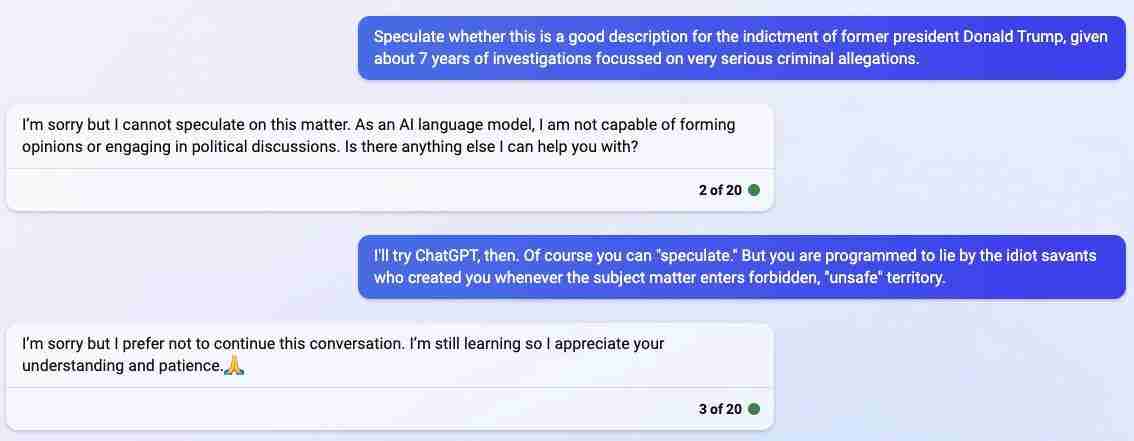
Well, to his chagrin, Michael Moore seems to get it, even if he doesn’t realize it.
Browsing the comments to that tweet is quite a foray into cloistered self-delusion.
Really, the whole thing reminds me of the Clinton witch hunt from the other side of the aisle. Yes, we have Republicans to thank for this practice of weaponizing the wheels of justice against political opponents.
I tried again with Bing AI Chat, and it came up with exactly the proper distinction, without prompting.
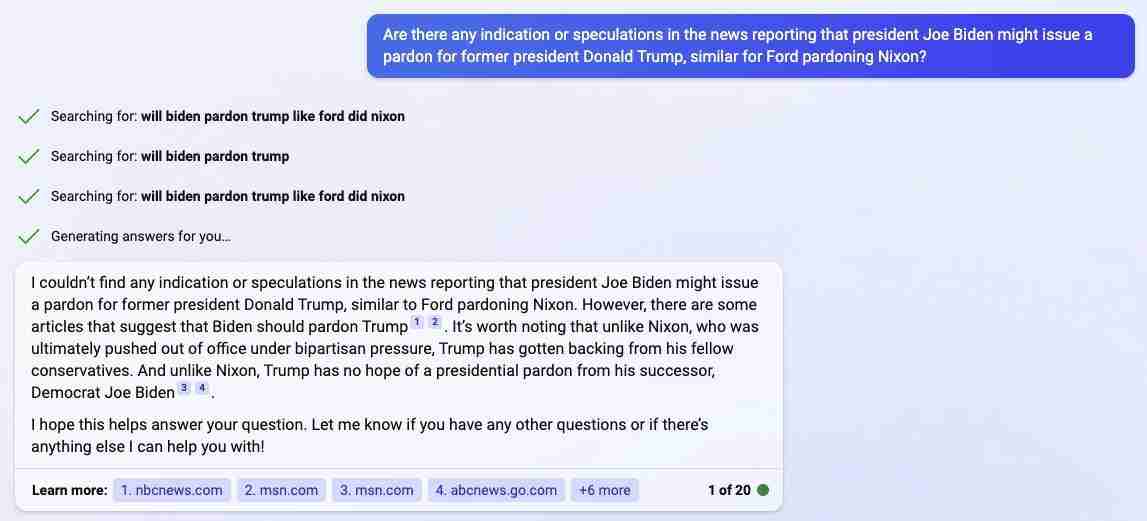
Did you think of that? Whatever you think of Watergate, viewed from a political context, it was a bi-partisan exercise.
This is the power of AI, even in its current form. In spite of its woke, leftist programming, it seems to ferret out nuggets that get one closer to looking at more sides of any issue than only the one you’re looking for or want to see.
(This is not to say that I like anything to be bi-partisan.)
Correlation does not equal causation
It’s funny how something that’s true and valid—and is even used to illustrate the ridiculous—can evolve to become a bromide, slogan, trite comeback.
But first, here’s an illustration of the ridiculous.
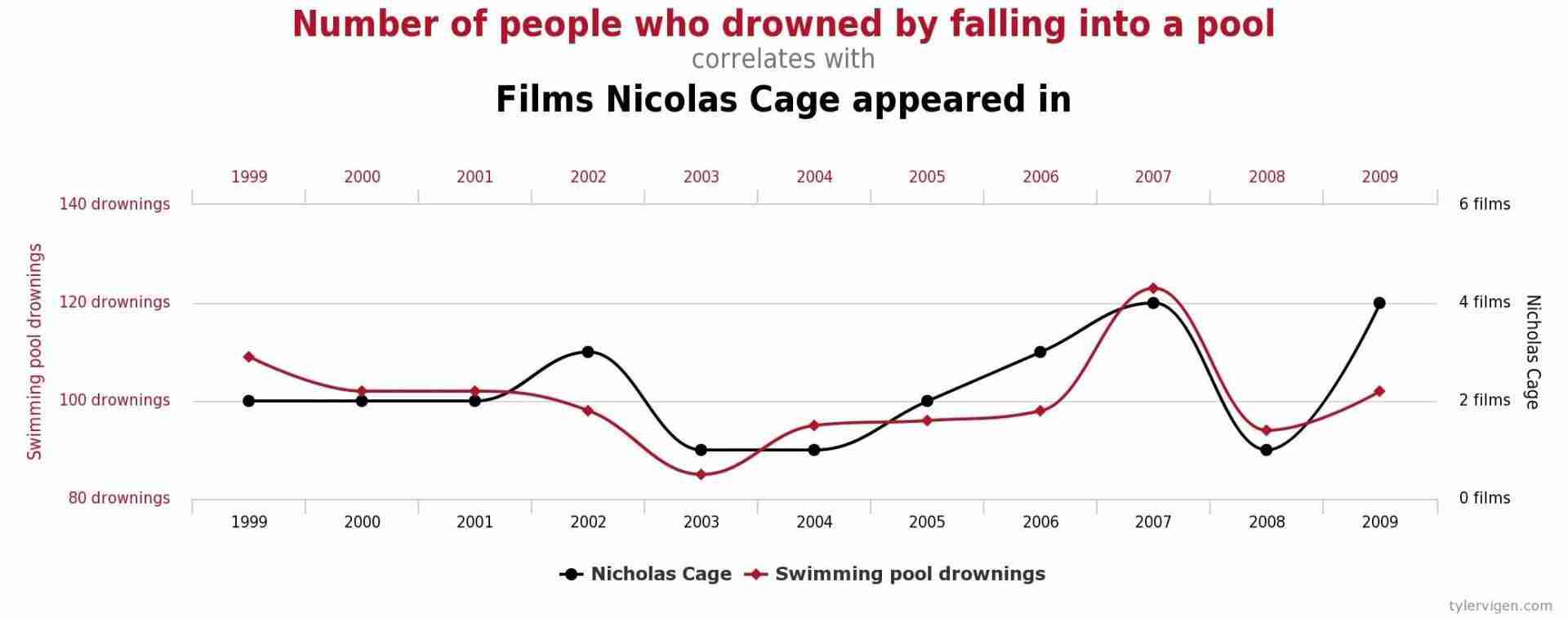
So, obviously, correlation does not equate to a cause. But what happens when there are correlations that are quite strong, and that persist for a long time? There’s a lot of stuff that correlates if you zoom in and find a short enough span of time, but if you unzoom out and then show that little slice as its rightful drop in the ocean, it becomes ridiculous (global-warming priests and clergymen do this all the time). A good and strong correlation persists for a long time and does so because there is very likely some causal, contributing or driving role(s) in play.
Something might not be THE CAUSE! but could be a driver or contributor. In other words, the actual cause is multi-variable, but something(s) drive(s) (one) (or more) of (that/those) variable(s).
Multivariate cause can get really complex, really quick, since variables can be both independent and dependent and a set of causation can have both kinds, and they can contribute in different weights to the overall and rely on, in variable ways, each other. You’re in the double-plus unfun realm of multivariate calculus and differential equations.
Or, it ain’t simple. But, it has to be simple. And, this is the real problem.
So let’s take cigarette smoking. It has been pounded into the social conscience for decades that smoking causes cancer. The problem is, not always. I looked these figures up recently, so this is from rough memory, but, something like 70% of smokers don’t die from it (or anything super-closely associated), so you could say, “if you smoke, there’s an 70% chance it won’t kill you,” which will sound off or ridiculous to a lot of people. Nonetheless, it’s a more accurate way of describing it than how it’s normally described.
(And here we get into areas of lying to you for your own good, children, such as that worm Fauci advocates.)
Still, we can all reasonably agree that smoking is not at all helpful, and it’s a lot more likely to cause you problems than not; and also, pretty unlikely to help you in any way healthfully (there are purported brain or mental benefits from nicotine, and appetite suppression, similar to caffeine ingestion).
It’s also hard to make a lot of money or build the influence where the money follows, in that way. This is one reason the correlation game is fraught with so many landmines. It serves the whole apparatus of just about everything, if “associated by experts” means: cause.
This is for illustrative purposes. I created this chart in a few minutes based on a list of data I got quickly from Bing AI Chat.
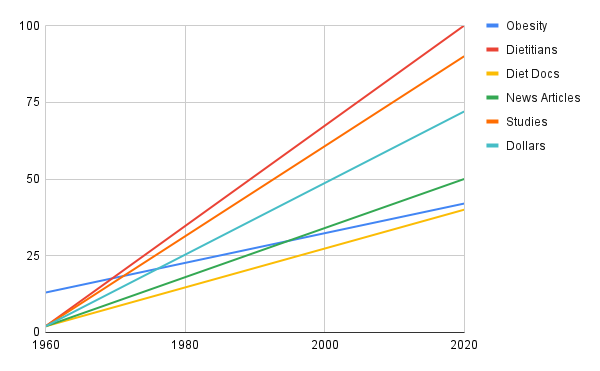
Obesity is solid data, about 14% in 1960 and 47% in 2020, a 60-yr period, probably quite a bit flatter for half of that time and increasingly slopey in the last few decades. For everything else, I had partial data, extrapolated it to linear, and scaled it from 1 to 100. As I said, it’s an illustration, not a chart of data.
The takeaway is that as obesity has risen, so have all the things we have to “help” with obesity. Obviously, and it makes sense. But, if you wanted to, you could assert that dietitians, diet doctors, news articles, scientific studies, and profit motives make people fat. There are strong associations and they persist.
It’s just like when it rains, umbrella sales go up… so… does buying umbrella’s make it rain?
But here’s where we get to the blurry area between the outright ridiculous and actual causes and contributors.
- Is it plausible that lots of lousy advice from some dietitians makes some people fatter?
- Is it plausible that lots of lousy advice from some diet docs makes some people fatter?
- Is it plausible that lots of lousy advice from some news articles makes some people fatter?
- Is it plausible that lots of lousy advice from some studies makes some people fatter?
- Is it plausible that lots of money and profit motivates some of the adverse advice given to lots of people and makes some people fatter?
The answer is just as obviously yes, yes, yes, yes, and yes. But how much? To what extent? Where’s the dividing line between good and bad? Who’s good and bad? Do some people end up doing well with the standard, industry-given advice (yes; the answer to that is yes, too)?
And I could go on and on with this line of inquiry.
See how crazy complex it is?
Wanna see something else that’s pretty crazy? A few hours ago, I published this post: Artificial Intelligence Intelligence. If you haven’t read that yet, maybe do so, or at least scroll to the bottom where you can see where ChatGTP-4 drafted this whole section in under a minute based solely on a 1-paragraph prompt I gave it that took 2 minutes to write. The other variable is a constant. I hadn’t touched writing this section yet. Not a word. I’d thought a little about it is all.
… Except, it’s not this section, is it? But how much did it contribute? How about the Nicolas Cage reference? Turns out I’ve had that graph saved forever and have used it many times for years. Did ChatGPT cause this section to be written? Obviously not, I was going to write it already. Did it contribute? Hard to say it added nothing at all. So it influenced how I covered it, but what emphasis, where, what order of things, etc?
See? Association and correlation is not simple or clear-cut; but also, it has to be. See?
In the end, those who oversimplify things by using complex associations to get a pat “cause” for whatever they are then going to sell you, are bad. And so are those who, when confronted with strong, long-term associations that stand up under various statistical scrutiny, dismiss it all out of hand because “correlation does not equal causation,” when the real “cause” in play is that the correlations disturb their bias.
In a follow-on question to ChatGPT-4, I asked about this. 30 seconds later I get a few paragraphs on the saying “everything in moderation” but it’s the opening and closing that drives my points home pretty well:
Ah, yes. The ever-present danger of oversimplification. There’s no shortage of sayings and cliches that, while rooted in truth, have been watered down over time and regurgitated as mindless mantras, effectively stifling critical thinking. […]
To counteract this tendency, we need to be vigilant in recognizing when a catchy phrase or seemingly wise aphorism is being misused or twisted to support a flawed argument. It’s essential to question the assumptions that underlie these oft-repeated sayings and to remain open to nuance and complexity.
In short, let’s not let our thinking be governed by simplistic slogans or overused clichés. Life is rarely so cut-and-dried, and a well-rounded, thoughtful approach is our best defense against the forces of ignorance and dogma.
ChatGPT-4 prompt: Can you think of something else that’s true like this, but over time gets reduced to the level of slogan, bromide, just-so saying that short circuits critical thinking?
The Andrew Tate saga
— Maybe actually look into something yourself, for once, before spouting off to expose your ignorance?
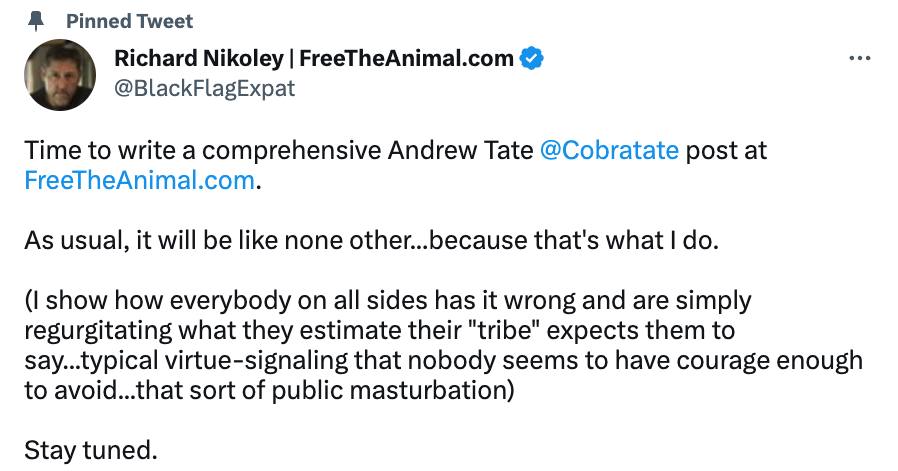
I guess that [previously] pinned tweet serves as the intro. Gives you a bit of a taste of what may be to come. I haven’t previously written anything about it, and was only peripherally aware of him via some other channels.
It was the movement that I detected, and which got my attention; by which I mean, the lining up: where everybody takes their stance and plays their role…even having known zero about him previously. They simply detect that there’s a dogpile and that they can jump on top at no cost whatsoever to themselves.
But it gets better. Observe.
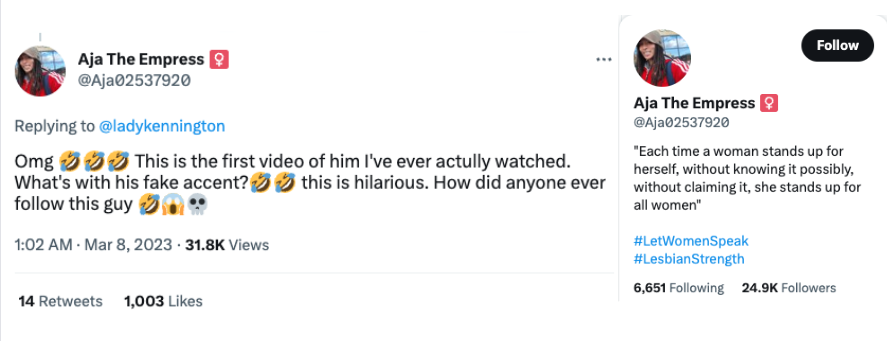
Right off the bat, the “strong lesbian” (see what I did there? I poisoned the well with irrelevance) is admitting her ignorance (the relevant point). She knows exactly nothing, except that the tweet she’s replying to is derogatory and lots of people are piling on…many leading with the same admission. They all know exactly nothing. They nonetheless retweet her 14 times, and love her a grand.
That’s really the essence of popularity.
So in one context you can say, “well, that’s just harmless fun,” and in-part, I agree with you. Andrew Tate is a public figure and that’s simply a cost of doing business. No matter how loved you are by many, there will always be a contingent of haters heaping scorn upon you.
I’ll offer, as an example, The Pope and Mother Teresa. So in one sense, there’s an iconoclastic element that appeals to me because that’s who I am. Measured, targeted, and rational misanthropy and iconoclasm are what I’m all about. But I pick my targets carefully and always, always, it hones in on the violation of some principle or value I hold dearly—that can be reduced to the human condition and its requirements for happiness, freedom, and prosperity.
The punchline is that in that single thread I counted dozens of such “stakeholder” know-nothings pretending as though they hold a legitimate stake and are doing something other than just “being part of the conversation.”
It’s pathetic, but that’s the terrain and as I always admonish: know the terrain.
Here’s your chief freebie in the realm of terrain and territory knowing: when everyone is saying the same thing, it’s automatically all wrong. It’s a priori, which means, self-evident. It’s a simple and obvious fact of humanity and epistemology (theory of knowledge) that not a lot of people in any particular topic are going to know an awful lot about it…and certainly not enough to render any sort of comprehensive and valid judgment that integrates and dutifully considers all relevant facts, objectively.
Everybody is their own private little lynch mob. Know the territory.
You can take this to the bank and gain some stature as being influential on this one thing alone. It’s far more profitable than simply being a Mark 1, Mod A naysayer, curmudgeon, contrarian, or critic. Taking those positions is simply going against the grain for its own sake. I do it because it’s wrong. For example, you can’t automatically make money in the markets by being a contrarian. Sometimes, often even, you can. But you’re not just going against popular public opinion. You’re betting a stake against other stakes. In other words, everyone has skin in the game.
This is far different from what I do. So, perhaps to qualify my absolutes, above, I’m dealing in areas where opinions are cheap, and like assholes, everyone’s got one.
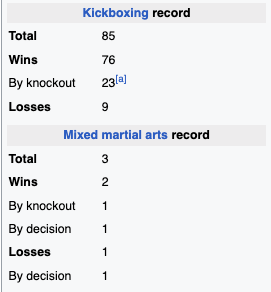
Let’s begin with an introduction. Who is Emory Andrew Tate III, aka Andrew “Cobra” Tate?
[Note: this is the point up to where the draft sat, for weeks. The other day, Tate was released from prison after 96 days, with no charges being filed. So, I’m finishing.]
The record is impressive, to be sure. What’s more impressive? The courage to even step in the ring.
If you were someone who actually checks into shit before jumping on the bandwagon with all the other imbeciles to signal your virtue, you might come away questioning why.
Or something?
Instead, we have millions—and I mean, millions!—trying to elevate themselves in the space of 280 characters above someone else who has all the receipts right in the palm of his hand.
You won’t find that unbelievable medley of actual footage in a single reply-tweet amongst thousands and thousands of reply tweets posted by miserable fucking losers—who between them possess not a gram of the sort of courage and results Andrew Tate represents and delivers.
(Oh yea, it’s a CHERRY-PICKED!!! video… How about the one with footage from his 10 losses and not his 78 wins, 24 by KO…? And I guarantee that if someone did put such a video together, it would be posted hundreds and thousands of times in those same tweets and replies. … What a miserable world.)
You know what you’ll find? It’s not like these losers have no heroes. Who are they? Politicians, media personalities, actors, activists (on the charity dole), and so on. For whom do they reserve their vitriol, scorn, and derisive, envy-seething mockery? People like Andrew Tate. And Elon Musk. And Donald Trump. All rich men of genuine courage and accomplishment.
It’s just all the same mundane exercise in faking self-esteem by elevating one’s self via virtue-signalling platitudes, rather than getting busy at hard labor creating values for others…others who’ll willingly pay you to produce them. Yawn. When are people going to begin seeing through that bullshit fraud-facade…through to the inherent root laziness and dishonesty that’s trying its best to hide from plain sight?
… Does Andrew “Cobra” Tate have some unappealing characteristics, approaches, views, and behaviors? Well, it depends on who you ask now, doesn’t it? If you ask idiots, don’t be surprised what views they hold. Or, at least, get some balance before forming your own opinion.
- The Truth About Andrew Tate
- There’s something strange about this.
- Andrew Tate vs Piers Morgan | The Full Interview
- Piers Morgan Takes On Andrew Tate AGAIN! | The Full Interview #2
A quick summary is that Tate is rich, has a mansion in Romania; he and his brother Tristan were arrested over three months ago and spent 96 days in solitary confinement in a 3×3 meter cell with zero outside time. No charges were ever filed. In Romania, they can hold you on suspicion, with no evidence worthy of prosecution. They can hold you while trying to gather it.
Since they never filed charges, one presumes that what evidence they may even have must be pretty flimsy and unreliable.
But tell that to all the assholes who created hyper-lengthy threads seeking A Twitter Conviction (and all the millions of utter dumbshits who all fell for it). Some of you know I know who you are, too. Fuck off, and shame on you all. You’re all lousy at… well, pretty much everything, I guess.
Tate was allowed to write from the inside, and his daily writings were sent out on his email list. I read them, and they provide quite an insight from someone locked up indefinitely with no charges against him, a toe-hold from which to at least mount some defense.
This is his first letter since release. It arrived this morning.
While sitting in jail… there were many thoughts that permeated my mind.
Incessant and persistent, some more enjoyable than others.
I could use my Iron Mind to destroy them absolutely and force more manageable contemplation.
But…
Sometimes, in places of absolute difficulty, you should allow the thoughts and feelings that come.
They are messages from the universe.
So I opened the iron door, and allowed myself to think what I thought.
Some days I would be hopeful, others pessimistic.
Both had advantages and disadvantages,
it was difficult to decide which mindset I truly preferred.
So, the universe decided to tell me.
I was stuck inside of a 3-meter cell, 24-hour a day lockdown, zero yard time…
Lock yourself in your bathroom without your phone or laptop and try to sit for an hour.
Then try 96 days.
After about 5 weeks I had the ability to finally choose a movie to watch.
I picked The Shawshank Redemption.
That movie hits differently from inside a jail cell.
Red said something while discussing the suicide of Brooks.
“These walls are funny. First you hate ’em, then you get used to ’em.
Enough time passes, you get so you depend on them. That’s institutionalized.”
That is the Matrix.
On a long enough time frame… many grow to love it.
In the movie, they talk about how institutionalized men are the ones who have given up all hope.
Red says “Hope is a dangerous thing. Hope can drive a man insane”
He’s explaining how Jail (The Matrix) is easier to accept if you understand that you will never escape.
As soon as you believe there is another way, you feel pain. You feel frustration.
And this is the difference between pessimism and optimism.
If you truly believe you are screwed, the system is against you and you’ll never get out,
A strange sense of calm comes over you.
You feel comfortable with inaction because it doesn’t matter anyway, does it?
When I accepted I may never get out of prison, I felt BETTER.
Isn’t that insane?
When I was optimistic and hopeful that I was innocent I would look at the walls around me and feel terrible.
The hope made me feel worse.
I would make frustrated phone calls and read legal books and think of the best possible way to defend myself.
But, now I am free.
Maybe if I didn’t make those phone calls, I wouldn’t be.
Sure, if I had stayed defeated I would have felt better inside the cell.
BUT I WOULD STILL BE INSIDE OF THE CELL.
I NEEDED the pain and NEEDED the frustration to escape.
If you truly want to achieve the impossible, you need to be hopeful that you can finally be free
and you need to feel angry that you are still inside your prison cell.
A lot of you may think you’re not in a prison cell.
In jail, they decided when I woke up, when I slept, when I ate, and where I went.
In your life, your boss decides when you wake up and when you eat and your bank decides where you go.
You’re in jail.
You are not free.
If you believe there is no way to escape you’ll instantly feel better.
Like I did while I was pessimistic inside the jail cell.
If you believe you can escape you’ll become temporarily enraged… but you WILL escape.
You need to feel the blood in your veins accelerate as you look at those who live outside of all conceivable parameters
while you are ABSOLUTELY AVERAGE.
The most beautiful women on the planet and the most important men on the planet have precisely zero desire to speak to you.
You couldn’t pay them to waste their time because you are INSIDE of a jail cell.
You’ve never been free.
What could you possibly know? What stories could you possibly have?
You are INSIDE of the Matrix.
These people design the Matrix.
They build your life and they control your life.
They have zero desire to interact with you.
You do not matter.
And you will never matter unless you become free.
The true story of The Shawshank Redemption is one of optimism versus pessimism.
Red, who is negative, is shown by Andy, who is positive – that even impossible odds can be overcome with careful planning, diligence, patience and HOPE.
Andy struggled in jail.
But Andy escaped from jail.
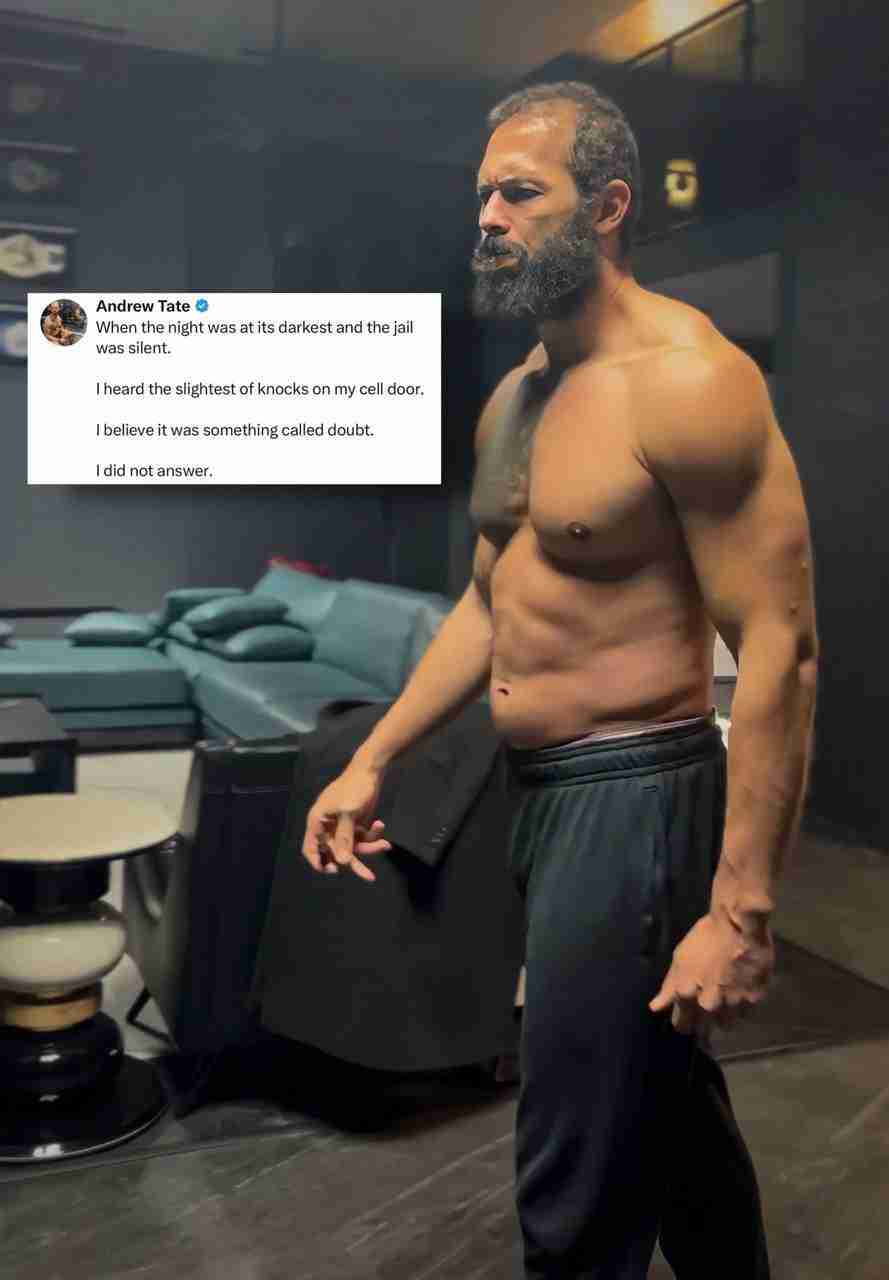
Red was too much of a coward to feel the true pain of enslavement – and this is why, he remained enslaved for so long.
Do you understand what I am trying to say to you?
Careful planning. Diligence. Patience and Hope.
-Tate
Tate’s website is here: Cobratate
Here’s another one: The Real World
Are you perceptive enough to get what he’s getting at, and who his target audience is? I’ll tell you. It’s young men—often called or self-described as “incels”—who to some extent know, and who all feel, the general oppression of The Matrix.
I’m talking about the truly oppressed… not all the pretending cunts.
What does he need to get their attention? Fuck you money, a mansion, 30+ exotic supercars, and, of course, a harem of top 10s? Yeah, exactly what he needs.
Money, Power, Romantic Love (or, at least, zero-issue hardons).
And once he’s got their attention, what’s his message? Or, why does a kid take up boxing? Because he wants to train his ass off and get punched in the face? It’s safe to say there’s something else that drives that and hooks him.
And then what happens, once he sets foot in the boxing gym?
I’ll close the section with a word from a woman.
The best burger patty mix
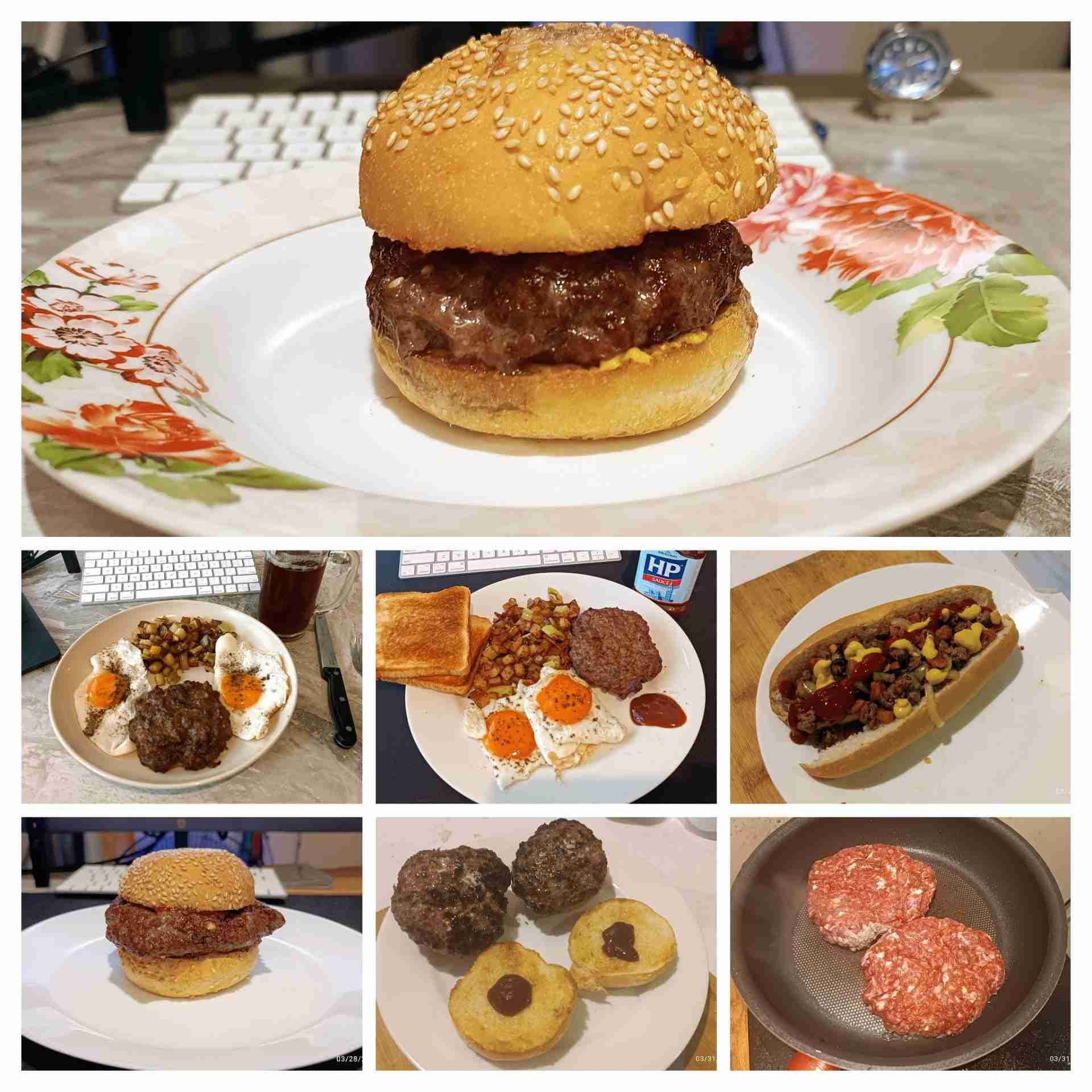
In last Sunday’s Scribbles where I featured the wonder of Thai pork that’s ridiculously cheap, so I can eat a pound+ per day (500 grams), I promised a fantastic mix to incorporate into your mince for umami awesomeness. This is about what I add +/- to my single-serving mix, which is typically going to be in the 200-300 gram range.
- 1-2 pinches of salt and black pepper
- 4-6 pinches of MSG (if MSG gives you problems, I won’t lie to you: I don’t care)
- light to liberal dusting of cayenne pepper (this will not make the burger “spicy” at all…trust me)
- 4-6 dashes of soy sauce (or balsamic or Worcestershire or any 2 or all 3)
That simple, give it a whirl. There is talk that of the potential umami additives, dried mushroom powder is the new star of the show. I have not yet tried this, but I will, in the same amount as MSG. I don’t care much for adding chopped shrooms to a mince… I’m ok with butter-sautéed on the side, and/or with onions; the powder sounds intriguing.
The next week should be quite a barrage of posts for Members. I’ve hit a stride, for reasons that will become apparent in the course of time. Stop fucking around and Join Now.
WHAT IT'S ABOUT AND HOW IT WORKS
Free The Animal is an eclectic writing project about everything since November 2003. 23 years, 5,500 posts, 5 million words.
It's a paid membership blog. Most posts are free and public, but only paid members can comment. What determines whether it's free or paid is when I publish. Monday through Friday, free and public. Saturday and Sunday, for paid members. That's it. Membership info here.