
Turns Out TikTok is an Amazingly Slick App
When Will We Learn to Evaluate For Ourselves?
TikTok. The app everyone loves to hate. When did I first hear about it? Can’t recall exactly, but it was definitely in a negative context. Chinese company, they said. A way to corrupt Western society. Same old story, just a new face.
Western culture. Society. It’s built on a foundation of regulations, commandments, and endless admonitions. Yet, it’s inherently corruptible. It’s baked in the cake. Think about it. If you create a society designed to control people into certain behaviors—ostensibly better ones—while prohibiting things people naturally want to do, but that don’t harm anyone else, what do you get?
A rational society and culture would only prohibit actions that objectively harm others. Murder, rape, kidnapping, theft, fraud. You know, the basics. Anything beyond that? Let families, villages, small communities, social shame, and ostracism handle it. Welcome to Christianity. Welcome to hypocrisy.
Do you get what I’m saying?
So, the obvious question is: Oh, so now you’re a fan of TikTok? You go in there and look at TikTok videos
No. I think I did that once a year or two ago, and you know, it’s just not my thing at all to sit there and scroll through videos. What I’m talking about is TikTok as a creator platform. How did this come about? Well, as I discuss far too often, I have all these Thai chick friends, and some of them have TikTok accounts. They want you to look at their latest creation and see that one video—although, they’re not really videos. They’re “shorts.”
And I was thinking to myself, not disrespecting them, but they’re not smart enough to do that. That’s what grabbed my curiosity. How can these relatively simple chicks, who are not tech-savvy except for their proficiency with phones—that’s all they’ve ever known—create these videos? They’ve never owned a notebook computer, but they know how to work phones and phone interfaces.
My advice is, if you’re getting started in creating on TikTok, just use the phone app. The reason? It’s a native phone application that sources from your camera, both photo and video. How easy is it to make a video? Unbelievably easy. You just go in, bring up your photo album—you can have years of archives in there. You can scroll down, say you did a vacation a few years ago, select four or five photos and maybe a video or two, hit next, and it stitches them all together. It zooms in, zooms out—brilliant.
Then it adds its own suggested music, but you can scroll through and try different music tracks, all royalty-free so you don’t get flagged. Hit next, and publish. It’s unbelievably easy and it’s good. It’s good enough for a short video; it’s impressive. That’s what got me in there, because I was like, how do these people create these impressive little short videos? They’re cool.
So, why would I do that for myself? Well, they seem to get some level of traction. People look at them, they like them, and maybe they follow your channel. They see whatever you produce comes up in their feed. After they’ve seen you for a while, they think, “I like this stuff,” maybe they check out the link in my profile, go to FreeTheAnimal.com, and have a wider experience and become a follower.
That’s the logic behind it.
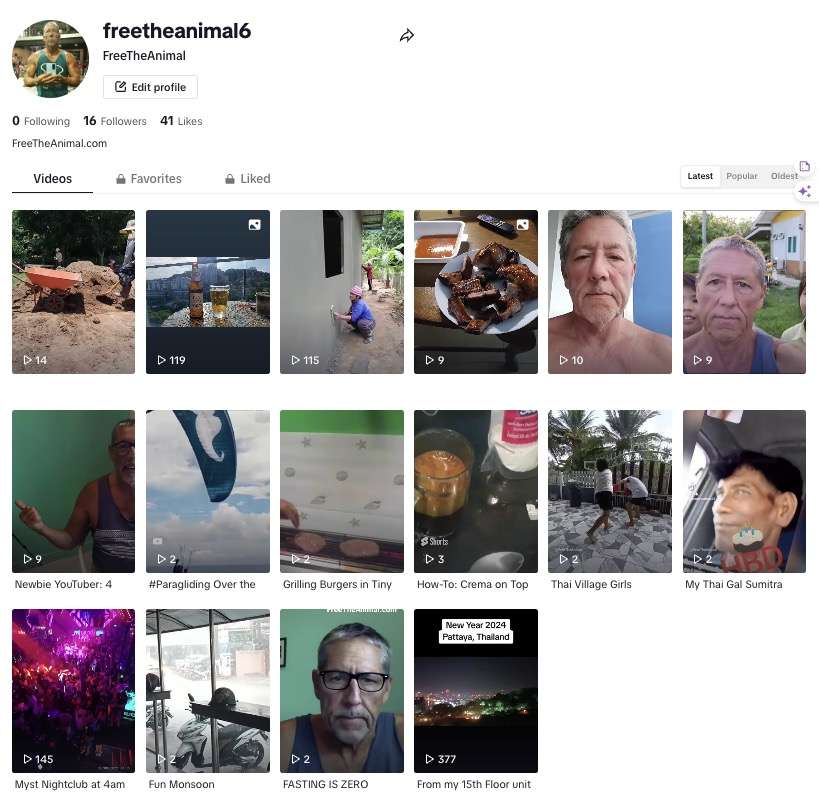
16 Shorts created in roughly minutes. Give me a few hours, I could have a hundred. Give me a few days, I could have hundreds and hundreds. All right from the photos and videos on my phone.
Here’s the link to the channel.
… Let’s contrast that with my YouTube channel. My first video was published in 2006, 18 years ago. I’ve published 408 others, since then. Hundreds of hours of work. Of course, it’s not the same sort of content, but YouTubes are laborious. You need video editing software, you need to know how to use it, mash it, upload it, process it, and so on it goes. It’s a PITA.
And that’s just to make my crapy vids. Many top content creators spend days editing a single vid. Of course, they’re going to high-value production and making money off the Tubes themselves. For me, I’m just fishing to get hits on this blog.
I just published this one TikTok just now that inspired this post. Far, my current best friend has been up in Nikhom Kham Soi in Mukdahan for a few weeks now working on her house.
And by working, I mean it. She’s 44-years-old, mother of three, and weighs all of 44 kilograms (97 pounds). Puts many young, fat, couch-potato Western men and women to shame. Billions of them, in fact.
She sent that vid to me on the LINE application, the most widely used messaging app in Thailand. I clicked it, shared it to the TikTok app, it transferred right over, and then I scrolled to choose music, and publish. Under a minute.
… This next one was a bit more complicated. She had sent a few vids and photos over a few days. I just selected all of them, all of the stitching and editing was done auto, and I just left the default music. Maybe a minute.
This is one that took an equally short amount of time and was even easier because I had taken the photos and videos on my own phone, and that’s precisely what TikTok is made for.
… By the way, in case you care to enjoy what a sweet cutie that hardworking little Far is, there’s this YouTube road trip vid from a coulple of months ago and she features prominently.
… I was reflecting on the early days of personal computing, which emerged in the late 1980s with the advent of the first PCs, IBM clones, and the DOS operating system. The early adopters were predominantly tech-savvy, geek-minded dudes. I was one of them. There was immense satisfaction in mastering this technology and knowing how to use it. It’s akin to HAM radio operators who accumulate gear and figure out how to use it all. That’s how it started—a process that needed to be gone through, much like mastering hand tools before power tools came along and then mastering them for getting more done in less time.
Computers, though, are a different beast. They’re programmable machines. The PC revolution was underway, and then Steve Jobs entered the scene. Jobs understood that while tech enthusiasts enjoyed delving into the intricacies of computing, if computers were to become widespread, they needed to be accessible. People didn’t necessarily want to use a computer; they wanted to get things done. Jobs made this a reality. Early Macs didn’t bombard users with complex settings. You could modify them, sure, but you had to dig deep. This approach was crucial to their success. Microsoft followed suit with a similar philosophy with Windows 95.
But here’s where the future really gets interesting. This is a message I’ve been conveying about AI for a long time. Artificial Intelligence runs on computers, and it’s a game changer. Previously, to fully access a computer’s capabilities, you had to learn its language—various codes and programming languages. AI flips that script. It essentially is the code. Large language models have taught computers to understand and speak human languages—all of them.
In the not-too-distant future, AI will handle all coding because it is the code. We’ll communicate with it in our language. Imagine a five-year-old or a ten-year-old telling a computer what they want, and the AI writes the application—be it a desktop or phone app or something else—almost instantaneously. You play with it, tweak it, and tell the AI what to change. This is the trajectory we’re on.
It’s about getting things done. It’s always about that.
WHAT IT'S ABOUT AND HOW IT WORKS
Free The Animal is an eclectic writing project about everything since November 2003. 23 years, 5,500 posts, 5 million words.
It's a paid membership blog. Most posts are free and public, but only paid members can comment. What determines whether it's free or paid is when I publish. Monday through Friday, free and public. Saturday and Sunday, for paid members. That's it. Membership info here.