
Well here’s what I think… #1
It’s not what you think, so don’t relax

Greetings from Pattaya, Thailand for the 1st full-fledged publication of Well here’s what I think… If you missed #0, my announcement email yesterday, it’s right here. In brief, this is a weekly newsletter by email (archived on the web). 104 free articles per year. There’s a premium level but the two free articles come first, and members of FreeTheAnimal.com get all five weekly articles in a single post over here.
This week:
- Poor Messaging Plagues Low-Carb Dieting
- Is It Embarrassing To Be An American?
- Bonus Free Article: Rapid Change to a Whole New World
- Further Refinements To The Energy / Pre- and Post-Workout Drink and The 100% Cure For Heartburn
- Eight Solid Months In The Gym; Now My Own Full-Body Bust-Ass Routine
- What Five Months of Hyper-Dating in Thailand Has Taught Me About Female Psychology
1. Poor Messaging Plagues Low-Carb Dieting
I thought it would be appropriate to write the inaugural article of this newsletter on a subject that I am quite recognized for, or perhaps infamous for, having been an influencer in the Paleo diet era. This period encompassed various dietary approaches, including low carbohydrate diets, carnivore-focused diets, and even ketogenic diets. However, it also emphasized the consumption of plenty of plain whole foods. One of the remarkable aspects of the Paleo movement was its inclusivity, which is why it did not endure.
In simple terms, poor messaging means not being honest or upfront about the difficult or unpleasant aspects of something. Instead, people try to convince others by telling them what they want to hear. For example, when it comes to dieting, many people think it will be easy and painless to lose weight. But the truth is, losing fat is never easy, quick, or painless. However, a low-carbohydrate diet can make it easier because you can still enjoy delicious foods like meat and fish that tends to push out junk. Unfortunately, instead of promoting this approach, we often use poor messaging. Two recent examples.
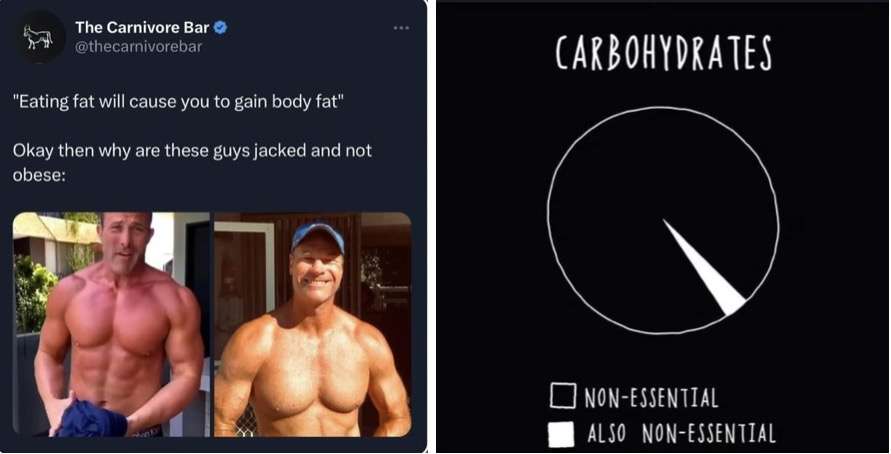
Poor messaging. In the first image, all accumulated fat is from dietary fat. So, when you get fat, the fat in your diet is in play. Yes, there are fringe ways in which you can make fat from other things. The elephant in the room is indeed the elephant in the room and when it hears the beating of hooves, it thinks horses—even though it lives among zebras.
Proper messaging is that there is an all-important oxidative priority at work whenever you eat.
Alcohol —> Carbohydrate —> Protein —> Fat
The priority (the order in which food is metabolized on the biochemical level) is inversely proportional to the body’s ability to store it. I.e., alcohol has zero storage capacity, so its energy (7 kcal per gram) is processed first…and fat is the easiest and most abundant to store, so unless there’s nothing ahead of it, it’s getting stored because that’s how the body operates.
If you’re operating at energy balance on average, daily, this is no problem. What fat gets stored gets unstored later and metabolized for energy.
The problem is eating both too much (too much fat in the presence of alcohol, carb, and protein) and too often (not allowing enough time for last meal stored fat to get unstored and used for energy).
That’s how fat gets accumulated over time.
So, yes, you do have to be mindful of both how much fat you’re eating meal to meal, and how often you’re doing that.
… In the 2nd example, you see this all the time and the desired implication—which keeps people engaged in fandom on non-essential things—is clear: low-carbohydrate diets are best because you don’t absolutely have to eat them, which is true. Also true:
- The average human with normal fat stores can go 60-90 days with zero food intake (this is known from studying IRA hunger strikers all the way to the bitter end). Thus, food intake for 60 days for most people is non-essential. Your body makes energy by catabolizing fat and muscle…probably even bone for minerals. The big benefit is that you’ll lose virtually all bodyfat. So, go for it. SHUT UP! IT’S NON-ESSENTIAL!
- Vitamin D is non-essential. You don’t need to eat any foods containing it. So, there’s probably a good reason not to…or, at least some diet you can sell on that basis.
- Vitamin K (K2 in particular) is non-essential. See Vitamin D. Just lump all the foods together that contain either or both, and since those nutrients are nonessential and your body can get them in other ways, feel free to abstain from all foods containing them irrespective of any other considerations. It’s the science.
- All manner of equipment and vehicles now have all manner of safety devices and procedures. Accordingly, you’re encouraged to operate everything in the fun zone. Why? For fun. Live a little. You’ve got backups and failsafes. Use them.
The discussions about carbohydrates in our diet often overlook the importance of carbohydrates. Our bodies have evolved over millions of years to ensure that we have enough glucose for our brain. The body has developed backup pathways to ensure adequate blood sugar levels. These mechanisms allow our bodies to produce sugar when it is not available in nature. This ensures that our brain gets the essential sugar it needs to function. So, when advocates of low-carb diets say that dietary carbs are not necessary, it seems disingenuous to ignore the fact that our bodies have developed these safety mechanisms because of the critical importance of sugar—for which dietary carbs are the most reliable source. It’s like hating something good or criticizing someone based on their virtues.
When you point out these elements regarding the non-essential nature of carbohydrates or dietary carbohydrates, you often get intransigence, pushback, and doubling down, which places it squarely in the category of religion.
One group of religious people are the fundamentalist Baptist evangelicals. They believe that having faith in Jesus Christ can forgive all sins and guarantee a place in heaven. To test their belief, let’s imagine a scenario: if Hitler repented and accepted Jesus before he died, he would go to heaven. On the other hand, there’s a philanthropist who did many good deeds for society but didn’t believe in Jesus, maybe because he was Jewish or followed another religion. According to this faith, the philanthropist would go to hell while Hitler would go to heaven. This may sound ridiculous, but if you ask any evangelical Christian, they will strongly defend this belief.
With this level of religiosity in mind, let’s address the carbohydrate conundrum—the notion of their non-essentiality, meaning that you do not need to ingest sugars through your diet because your body is perfectly capable of synthesizing them.
Now, whether you’re of the conviction that a divine entity crafted humanity or you subscribe to the evolution narrative, it’s perplexing to consider why mother’s milk—the sole sustenance for an infant for a significant stretch—contains a carbohydrate content that dwarfs the amount of protein by a factor of eight, and surpasses the fat content by one and a half times. This macronutrient is the most abundant component of mother’s milk, yet we’re told it’s not essential to consume.
Confront a devout low-carber with this, and they’ll likely regurgitate definitions, or they’ll challenge you to prove the indispensability of carbohydrates. The crux of the matter? What’s the endgame of hammering home the message that carbohydrates are non-essential?
Let’s dissect this. There’s a fundamental disconnect when one preaches the superfluous nature of carbs while nature or a deity has seemingly endorsed them through the very composition of mother’s milk. It’s essential to question the narrative, to peel back the layers of dogma and ask ourselves what we’re missing when we label a naturally occurring substance in early human nutrition as ‘non-essential.’
The pursuit here isn’t to worship at the altar of carbs but to advocate for a nuanced understanding of human biology. It’s about asserting the authority to question the status quo, to dig deeper than the surface-level proclamations handed down by the so-called experts. It’s about wrestling control from the clutches of dietary absolutism and recognizing the shades of grey in our understanding of what nourishes us.
In essence, it’s not about carbohydrates per se; it’s about the principle. The principle that we must always be vigilant, critical thinkers, especially when confronting claims that seem to fly in the face of observable reality. It’s about ensuring that we’re not just passive consumers of information but active, discerning participants in the quest for knowledge. Only by doing so can we lay claim to the kind of life that is truly ours—one not dictated by others but forged through the fires of our own critical thought and lived in accordance with our own, self-determined moral compass.
Food for thought, with or without carbohydrates.
2. Is It Embarrassing To Be An American?
To quickly bring those of you who haven’t been following my journey up to speed, I inadvertently made Thailand my home beginning in January of 2020. My initial plan was to stay for two months and then gallivant around Southeast Asia. However, the global fiasco clipped my wings, and I found myself grounded in Thailand. I didn’t step foot outside of the country for nearly four years—just shy of that by two weeks, to be exact.
Come January of the current year, I boarded a flight back to the good old USA. The return wasn’t as strange as one might think, though. You see, I’d been a stranger to my birth country before. I lived in Japan for five years in the 1980s, and during that time, I only returned to the States once or twice. I also spent a couple of years in France. So, being away wasn’t a big deal, but this time, something felt off—like time dilation or some shit. When I left the US in ’84, spent six months back in ’89, and then hopped over to France until ’93, I noticed changes, but they were gradual.
This time, though? The shock was palpable. Maybe it was the extent to which I’d immersed myself in Thai culture—deep in the rural villages, fully steeped. But coming back to America, the sticker shock hit me first. Prices through the damn roof! The real kick in the teeth, though, was the sense that things just weren’t the same. I had left before the global health scare and the 2020 election circus. I hadn’t been around for all the shit that went down in the last two or three years.
In Thailand, I noticed something interesting: people from all corners of the globe—Western Europe, Australia, Canada—knew a hell of a lot about American politics. American politics has gone global, and while Trump was still in office, I felt a sense of positivity towards America, even from those you’d peg as liberal or leftist. But it’s not typically those folks who venture out and settle in a foreign country. Among expatriates, there’s a conservative streak, a shared disillusionment with how their home countries are faring. I count myself among that crowd.
Over time, my perspective as an American expat in Thailand shifted from one of enthusiasm and respect for my homeland to seeing it as, for lack of a better word, a bit of a joke. Mind you, back in the day, people made jokes about America, but it was in a way that you’d rib the big guy in the room. It was kind of nice to have the big guy to poke fun at, if you catch my drift. But now, the jokes and ridicule seem tinged with a sense of sadness. It’s like America isn’t the big guy anymore, and that’s a damn shame.
These are sobering to watch.
And I caught this in the Thai news the other day:
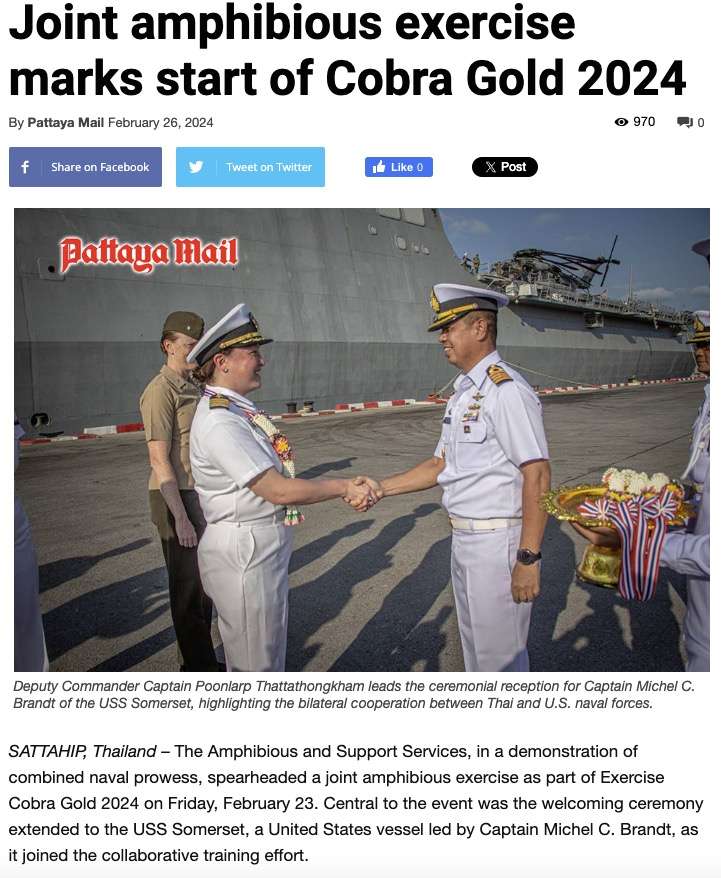
So the Thais send out a typical military commander, just as they did in ’86 – ’91 while I was visiting and was a US Navy officer myself.
And, as we ourselves did back then.
Now we send out chicks playing army man, one being unfit for either role.
Embarrassing. Also, if you ask me, an insult to the Thais.
3. Bonus Free Article: Rapid Change to a Whole New World
The question I’m asked most frequently these days, when people aren’t simply dumbfounded, is, “What the hell happened to you?” It’s understandable. In 2019, following an amicable divorce and selling everything, I headed off with a 60-liter backpack and money in the bank, landing in Chiang Mai, Thailand, on January 15, 2020. I had no clue what was coming down the pike, and even as the first few months unfolded—yes, you know what I’m talking about—I was disbelieving. As misanthropic and cynical as I can be, I dismissed the notion that this global phenomenon would persist. I thought it would fizzle out and prove inconsequential.
My confidence persisted even after my flights out of Thailand were canceled and the dominos began to fall. I made my way to a rural part of Isaan in northeastern Thailand and set about building a house. Covering the expenses for that was no big deal; I didn’t think this whole thing would last. But then I watched over the next two years, with lingering nonsense persisting to this day. Ultimately, I found my way to a small corner of the world at the very southern tip of Phuket Island, where I hung out and the authorities pretty much left us expats alone.
I had a lot of time to reflect. I had a lot of time to lose a lot of money and witness the destruction of one of my businesses. This, and more, motivated me to start making massive changes. The first of those was to dump booze entirely, on a dime, on August 7, 2022—about 19 months ago. And life has never been the same since. Here is what I reflect on now, inspired in some measure by Andrew Tate.
… The landscape has shifted. The old world is dead and buried, and what’s risen from its ashes is a beast of a different breed. Your cozy government nest egg? That pension fund is as safe as a lamb in a lion’s den. Your nine-to-five? It’s a paper boat in a storm of progress, and your dollar? It’s the plaything of central bankers, a puppet dancing on inflating strings.
The once-labeled “reckless” are now the new visionaries. Eschewing vaccines, forging their own paths in business without the crutch of a degree, plunging into the volatile yet lucrative ocean of cryptocurrency. Seeking refuge and prosperity in foreign lands, they’re playing a smarter game—one with low taxes, multiple passports, and insurance as a last resort, not a lifeline.
The men who dared to defy the status quo, they’re not just surviving; they’re thriving. Their wealth isn’t a mirage—it’s as real as the complacency that’s chained you to mediocrity.
You thought you were playing it safe, but you were just playing yesterday’s game. You’ve been making moves on a board that no longer exists, trying to win in a world that has moved on without you.
Competition is fierce, and only the strongest contenders will survive. Work-life balance is a relic, a luxury that the new world order can’t afford. As artificial intelligence sharpens its teeth, your cushy job is on the chopping block, and your employer will either shed weight or sink like a stone.
Inflation is a beast feasting on your pension, the very funds you’ve poured your life into. The dream of homeownership? It’s a nightmare, as debt shackles your ankles and drags you down.
You played it safe, and where did it get you? You’re in quicksand, and with every passing second, it’s pulling you deeper.
… And you aren’t even whistling past the graveyard of the old ways. You’re denying there is one.
You scoffed at risk-takers like Tate, branding them madmen for their relentless drive, for their refusal to bow to fear. But the irony is as thick as the walls of your self-made prison. In avoiding risk, you’ve landed in the riskiest spot of all.
The clock is ticking, and it’s high time to wake up. Tate wasn’t just spouting hot air; he was handing you the keys to the kingdom. To thrive now, you need to be the master of your destiny, to arm yourself with an unshakable work ethic and the guts to match.
If you’re seeking wisdom, a real-world education to navigate this brave new world, look no further. Welcome to the harsh truth of FreeTheAnimal.com, where we peel back the veneer and show you how to seize control, to build wealth, and to live with unapologetic audacity. The future is for the taking—if you’ve got the nerve.
4. Further Refinements To The Energy / Pre- and Post-Workout Drink and The 100% Cure For Heartburn
Two remarkable insights converged upon my reality within the past month. The first was an inadvertent discovery—a potential panacea for heartburn, or GERD as it’s sometimes labeled. The source? An influencer hailing from the realm of diet and fitness, Anthony Colpo—an Australian now embracing the expat life in Thailand. As we spent a month together, hitting the gym and breaking bread, I observed his curious habit at restaurants. No beverages ordered. No elaborate lectures delivered. His rationale was succinct: it impaired his digestion.
I pondered this. Wrote about it. Posted it. Made a download available. The gist? Forgo drinking while dining. If you must, sip sparingly. Observe animals; none pair a meal with a drink as if at some happy hour. It’s an odd concept, discomforting, uninviting. Yet, isn’t this discomfort merely conditioning? Throughout human evolution, a ready supply of liquid alongside food wasn’t a given. Watch dogs at mealtime—they eat, then perhaps take a modest lap of water, and that’s that.
Emulating this, my chronic heartburn—a lifelong nemesis—has met its match. Relief is consistent. Now, let’s segue to the next topic: the concoction of energy drinks doubling as pre- and post-workout beverages…that also became a topic to post about, and a download. Amidst my rigorous morning workout regime, I scouted for an optimal pre-workout meal—one that wouldn’t weigh me down yet energized me sufficiently. The marketplace is flooded with options, yet few are whole food-based, and profit often triumphs over quality or utility. If only hyperbole had calories I digress…
Experimentation led me to a fruit medley—apples, oranges, honey—with and without low-fat yogurt. Good, but not quite there. I got too hungry too soon. Then, the humble potato entered the scene—a microwaved spud consumed pre-workout provided sustained energy and staved off hunger pangs pretty well. A mix of the yogurt and a dash of cayenne pepper transformed it into a palatable potato salad of sorts.
The real game-changer was milk. Mark 1; Mod A. Whole. Cold. Having abstained for months since dumping booze, I reintroduced it—half a liter (about a pint) pre-workout—and the results were astounding. Energy levels soared, hunger was a no-show, and the remaining milk served as a post-workout meal…so a quart or liter in total, each workout day and that’s it. Though not protein-rich, milk’s benefits seemed beyond its nutritional profile. This could well be the holy grail of workout hydration—if consumed judiciously.
This revelation ties back to the heartburn issue. Limiting fluid intake to minor sips—about 4 ounces of plain water total—during meals averted the burn. It’s a compromise for those hesitant to forego drinks entirely, especially with spicy fare where a swig can quell the fire within.
However, milk was the anomaly. Introducing it alongside solid food in such small amounts triggered mild heartburn, leading me to speculate: Is milk inherently designed to be an exclusive food? Could there be a natural weaning mechanism that discourages its combination with other foods?
Food for thought, again.
Since then, I have only consumed milk all by itself. It seems best suited to that purpose. When used post-workout, I give it about an hour until I consume my beverage-free protein targeted solid meal. Your mileage may vary.
5. Eight Solid Months In The Gym; Now My Own Full-Body Bust-Ass Routine

The saga of my physical transformation began in July 2023, eight months past but to understand the roots of this tale, we must rewind to August 2022—19 months prior. My form was far from enviable, tipping the scales at 83 kilograms. My vice? Excessive drinking. A habit too often indulged. The solution? Curtail the spirits and turn to sustenance. My regimen consisted of walking, a dalliance with the water—swimming. The gym was not my temple then. The pursuit was not strength but health, vitality, not muscle.
Fast-forward eleven months to the inception of the ‘gym story’. Eleven months of transformation had added 5 kilograms, bringing me to a solid 88. July was the turning point—30 consecutive days of grueling gym sessions. My goal wasn’t the chiseled aesthetic of recomposition. No, I craved strength, mass, unconcerned with the tyranny of the scale. Within three months, the results were palpable—I breached the 99-kilogram mark, teetering on the edge of a full 100 kilograms, a robust 220 pounds.
As the calendar flipped to March 2024, I found myself at 92 kilograms. From the moment I shunned alcohol to the present, I had amassed roughly 10 kilograms of body mass, sculpting a significant amount of lean muscle while shedding considerable fat. A true recomposition.
Some preach the gospel of ‘lean first, bulk later.’ I stand in stark opposition. My journey is testament to an alternate path. With a rigorous five-day-a-week gym routine, each day an odyssey of exertion—leg day being nothing short of Herculean—I can assert that dieting, the kind that leaves you famished, is a detriment to performance. Starvation hinders gains. My philosophy? Fuel the body, then worry about fine-tuning.
Now at a crossroads, I’m shifting gears. The next endeavor? A workout book, crafted with my experiences as its spine. In under a week, I’ll embark on this self-experiment, a departure from the conventional splits advocated for advanced gym-goers. Full-body routines are on the docket—daily.
I draw inspiration from Anthony Colpo, an Aussie expat now in Thailand and my gym mate over the past month or so. His recent post on high-frequency, full-body workouts at anthonycolpo.substack.com echoes my sentiments. Consider the laborer, whose every day is a full-body trial. There’s no luxury of ‘leg day was yesterday.’ The body is an integrated system, and so should our workouts be—compound in nature, comprehensive in scope.
I’m designing 20 distinct full-body workouts, categorized by intensity: easy, medium, hard. The sequence will be varied, never back-to-back exertions of the same caliber. These workouts will populate a five-day weekly schedule for a month. Similarly, I’ll tailor plans for four-day, three-day, and two-day commitments.
This matrix of workouts will be a blueprint, a guide to be refined in the crucible of the gym. By next week, it will be mapped out and the trial by iron will commence with the five-day itinerary. From this trial, I will extrapolate the feasibility of the four-day and potentially the three- and two-day routines. But truly, if you’re whinging about a mere two days of commitment, we’re in different leagues.
Stay tuned. The journey from here continues with the relentless pursuit of self-improvement and the eschewing of platitudes. This is not just about lifting weights—it’s about lifting the veil on your own potential.
6. What Five Months of Hyper-Dating in Thailand Has Taught Me About Female Psychology
Over at FreeTheAnimal.com, under the category ‘Thailand Confidential,’ I divulge tidbits of my escapades in the Land of Smiles—particularly those involving the fairer sex, often considerably younger. Here, in this tempered iteration, I’ll discuss what I’ve dubbed ‘hyper-dating.’ Since my last extended relationship concluded in October, I’ve embarked on a spree of experimentation through dating apps. As a foreigner in Thailand, the dynamic is intriguing—what Western men experience in the pursuit of women is flipped on its head here.
Pattaya, Thailand, where I reside, is the Las Vegas of the Orient—a city that never sleeps. The dating apps buzz around the clock, with someone always just off their shift. My dating frequency has skyrocketed—several times a week, sometimes multiple dates in a day. The age range of these women spans from roughly 20 to 45. It’s been an enlightening journey.
There’s a persistent narrative in the West about the chasm of understanding between the sexes. Men often express bewilderment when it comes to deciphering women. However, with sufficient exposure, one begins to discern patterns. Despite all protestations, women inhabit a world of emotion and feeling. This isn’t to discount their capacity for rational thought—women are as capable as men of analytical reasoning. Yet, their default lens often filters through emotion.
So, how does one navigate this landscape? You can’t change it—it’s the nature of the beast. The key is to know the terrain and enjoy the ride regardless. My approach? Allow women their emotional space. Even if a situation seems clear-cut to you, if she feels differently about it, that’s her reality. Arguing or attempting to rationalize it is futile—like spewing hot air.
Case in point: I have a regular I see, and occasionally she’ll have an emotional outburst. For example, after leaving my phone on silent during a gym session, I returned to a barrage of messages—half in Thai, half in English. Sometimes I ignore them, but if I do respond, it’s succinct: “Calm down.” And you know what? It works.
I’ve ceased justifying my actions to these women. I state my position or preference plainly, without delving into elaborate explanations. It’s as if brevity is perceived as strength—as though stating your intention without justification signals confidence and resolve.
This realization made me ponder the unintended consequences of feminism. Society pressures women to adopt traditionally masculine behaviors, reasoning, and habits, which clash with their innate nature. It’s not a criticism, simply an observation. Understanding this has eased my interactions with women.
In Thailand, there’s a phrase: “It’s up to my feelings.” My advice? Recognize that you’re navigating a realm of feelings and emotions. When communicating, even if your points are rational, frame them in ‘feely’ terms for better reception. Secondly, don’t drag women into a world of strict rationality. They’ll venture there if and when they choose. Otherwise, let it be. Enjoy your time together without the burden of unnecessary explanations.
And hit the bedroom.
WHAT IT'S ABOUT AND HOW IT WORKS
Free The Animal is an eclectic writing project about everything since November 2003. 23 years, 5,500 posts, 5 million words.
It's a paid membership blog. Most posts are free and public, but only paid members can comment. What determines whether it's free or paid is when I publish. Monday through Friday, free and public. Saturday and Sunday, for paid members. That's it. Membership info here.
Over the course of my diet/exercise revolution, I have learned that carbs are absolutely pivotal to both my performance and my body composition. 300 or even 400 grams per day, and I feel great, look great, and perform great.
The keto/carnivore crowd now just looks so god damn retarded to me. Declaring glucose to be a toxin.
Obsessing over the antinutrients, oxalates, etc in plants. Missing the forest for the trees so badly. Children trying to sit at the adult table. Makes me cringe to remember I believed the same things not that long ago.
Caloric deficits do indeed suck to endure, in just about every way imaginable. Our ancient genes developed these physiological feedback loops to motivate us to go find food. I have learned that being sedentary is a terrible choice to make. Even if you lose weight, a bunch of it will be muscle. Body always wants to stock up. Might as well have it stock my growing muscles rather than my beer belly and love handles.
Then (earmuffs, carnivores) I cut the FAT out of my diet to lose the fat on my body.
You’re looking great dude. What odds do you give Trump this fall?
Trump is a Shoo In. They’ll do their best to steal it again, and millions of Biden ballots will be fake for sure, but it won’t be enough this time.
My suspicion is that the Democrats know this and so there is a good chance they won’t bother and take the risk of greater exposure. But if they do not pad it with millions of fake votes, it’s a huge devastating landslide and that’s a stink that never washes off.
Reagan’s landslides are still the stuff of legend.
I’m hopeful. I’d be lying if I said I had much confidence. I always seem to underestimate the average American consumer-citizen-voter’s stupidity.
Either way it will be quite a ride to November.
One more quip then I’ll shut up:
Truer words never spoken re: paper sailboats in torrential seas. Any government, corporate, or union job/pension/”benefits” are subject to the market’s most minor whims based on the vast tidal wave of ridiculously rapid technological evolution.
Better invest while the investing is good. Owning a piece of the pie is a much better than showing up begging for the crumbs.