
Sunday Scribbles #13
— Work & Play; Is Woke Fundamentalism in Decline? Is Everyone an Automatic Liar Now? Fasting: New Revelations; Sunday English Carvery Buffet

Getting started on this late what’s new? Oh, well, if I can finish it up in a few hours then you’ll be getting it Monday morning for most of you and had it arrived Sunday night you’d have probably waited anyway, losing no sleep over it.
At least this is how I can rational-lie it. You might find a theme in that italicized neologism.
A couple of brief introductory items. First, and a valid reason I’m late at this, is because I put up a pretty substantial post yesterday. It’s public, so open to all.
It’s a post about what’s going on, really, and how the intention published last February to start a construction and development company here has evolved, owing primarily to the intense work done recently getting the chatbots installed and chatting away with members. I found I like getting up way early (03-04.00 every morning) and plugging away with intensity. So, what has that transformed, and how has the building project evolved as a result? I hope you enjoy it. Better if you can find a way to apply it, because a core question I’ve found asking myself with respect to a goal, vision, or something already accomplished:
Yabut did you love it? (or, in the case of goals and plans, will you; and, foshoowa?)
The other intro piece is that the other part of that intense work stage—where according to my computer usage logs, I was averaging 4 hrs sleep per night, and not all at once—I ventured down some unhealthy paths like staying inside all day, no activity, no sun, no exercise, eat whatever whenever (though my food choices are always good, no exceptions). Nothing major, and this is why I like project-based work. It’s okay to compromise on health for a stage while you get shit done. It’s probably hormetic in acute bursts that only lasts days to a few weeks at most.
Then you correct it, and that’s what I’m doing. Basic walking, swimming, sunshine, and fasting (food choices are always good). I’ve discovered something about fasting I want to share in the last section before the closing food photos.
Is Woke Fundamentalism In Decline?
Ivor Cummins is a great person to follow on Twitter, a true man of sound science. Nobody worked harder than he during the Covidiocy to get the facts and reason out and now that’s seemingly waning—from fatigue and move on, if nothing else—he often turns attention to the anti-science climate-change scam and the anti-social woke scam.
I think it must have been this morning, I caught this post he retweeted with short video.
Not often do I see perceptiveness enough to link woke to commieism (and even less often, linking The French Revolution to the birthplace of communism…but that’s a subject for a different post). I don’t really buy all the conspiratorial stuff alluded to. It’s a good counter-narrative, however.
The game is geopolitics, and Trump showed that America can indeed be dominant through trade rather than military adventurism and planet-policing. The industrial complex doesn’t like that. Its shareholders, officers, directors and big-time investors calling the shots like Black Rock don’t like that. The likes of Gates, Soros, and Buffett don’t like that.
Trump was dispensed with, and having a military that fights for money and cheap narratives, rather than for God & Country, is good for business. People with morals and traditional values tend to get in the way of just doing your job and following-orders efficiency. It goes to troop morale and esprit de corps. America was the most successful winning military when it had ideas it believed were worth fighting for.
That process of degradation has been going on for decades, but at least the conflicts were linked to communism, an atheistic anathema to American ideals. You couldn’t get a more evil enemy. But that ended in 1993 and since, it has been a struggle to justify things, though they seem to have managed, and we’re in perpetual war, just what the machine needs.
It’s good for business.
So we’re in a predicament now where, given the message in that video, is woke designed to win, or is it designed to lose, but in an iconoclastic way, rendering America a shadow of its former self?
It’s an interesting hypothesis. It’s heads we win, tails we lose. Woke wins, we lose. Woke loses, we take down America in the process, and we still lose. Then it’s just a military with a bunch of mercenaries, not patriots.
Interesting hypothesis.
For a deeper dive into the investor element here, Black Pigeon Speaks put out a video a while back, WHY Companies MUST be WOKE or REALLY GO BROKE.
… This is the latest “The Next Bud Light,” in case you’ve been wondering.
I recommended that folks crush their children’s LEGO sets rather than burn them. I’m no enviro-wanker, but there’s already enough toxicity in the air.
For a more deep and serious take at all this, Britain’s Toby Young has a fine piece up, A Dispatch From the Woke Wars. I quote at some length. Most are familiar by now that this stuff looks, smells, and tastes more like a religion than a social-secular justice movement (though they all seem headed in that direction, the more hard evidence that piles up against them…and some day you’ll simply have to have faith that racism is everywhere, and it’s the devil). Toby puts a nice fine point on it, I think.
…[T]here’s been a ‘lab leak’ of what Elon Musk calls the ‘woke mind virus’. It would now be more accurate to describe it as a religion. That’s hardly an original observation, but it’s worth reiterating in case anyone is any doubt. The beliefs outlined above are not based on science or reason, but on something resembling metaphysics, as unassailable in their own way as the nature of Christ or the Holy Trinity. It has its own religious symbols – the rainbow flag – as well as a liturgy – Black History Month, Trans Day of Remembrance. It even has its own rites – taking the knee, ‘doing the work’, engaging in public bouts of racial self-flagellation. And it recently acquired its first saint in the form of George Floyd.
The idea that woke-ism is the first new religion of the 21st Century is why it’s sometimes described, half-jokingly, as the ‘Great Awokening’, implicitly comparing it to other outbreaks of religious fervour in the modern period. According to Wikipedia, there have been four ‘Great Awakenings’ in the past 300 years, the first lasting about 25 years, the second and third 50 or more, and the fourth in the 1960s and 1970s lasting about 20.
Paradoxically, even though the rise of this new religion has coincided with the decline of Christian worship in the English-speaking world – particularly among middle-class, middle-aged, white women – which suggests it’s filling a ‘God-shaped hole’, it has made converts within the established churches, particularly the Church of England. That’s a puzzle, but I’m pleased to note that some of woke-ism’s most energetic opponents are orthodox Christians, such as Peter Hitchens, as well as Catholic and Jewish intellectuals like Sohrab Ahmari and Yoram Hazony. They appear to have the best antibodies to the ‘woke mind virus’.
Most people trace the origins of the current religious awakening to around 2013, making it about 10 years old. Does that mean we’re in for at least another 10 years of woke-ism – possibly longer? One reason for thinking it might subside more quickly than previous religious movements is that its growth has been accelerated by social media and – presumably – its decline will be too. Twitter, in particular, has been one of the chief platforms for the dissemination of woke ideology, as well as for punishing those who dissent from it. That has begun to change since it was bought by Musk, although it may revert to type if he sells it to someone else.
https://dailysceptic.org/2023/05/27/a-dispatch-from-the-woke-wars/
The part left out, to my mind, is how certain schools of philosophical thought during the height of Soviet communism likened it to a religion as well…a replacement for the Orthodoxy they’d outlawed and mocked. But the masses, still in need of an opiate, found boxes to check in all the same basic catechisms with a different list of saints.
Everything changes, nothing is different.
Human nature remains basically the same, driven by mammalian evolution that’s 200 million years old.
… Yet another idea out there is to take the same sorts of actions against the churches of woke as has been taken by atheist and other 1st Amendment activists against evangelicals and other predominately Christian / Protestant faiths who insist that the separation clause in the US Constitution guarantees freedom of religion and not from religion. You had to be there (I was) to see how dadgum smart born-again Bible thumpers thought themselves when uttering such a critical and insightful distinction.
… Anywho, the evangelicals fought this and also went on the offensive over issues like prayer in schools, etc.
So in an ironic, be-careful-what-you-ask-for twist of fate, Evangelicals though they were getting children singing Jesus Loves Me, bowing heads and clasping hands in prayer…and what they got was a pedophilic, child mutilation sex-cult complete with trannies in black leather or vinyl drag, accessorized in whips and handcuffs.
You can’t make this stuff up.
Young delivers a welcome anti-eulogy.
Ultimately, it is the emptiness of woke ideology, its turgid unimaginativeness, it’s complete absence of a sense of humour, that will lead to its demise. It’s what George Orwell described as a “smelly little orthodoxy”, which is why it has inspired no great literature, no great art. It has no Cardinal Newman, no Thomas Moore, no Adoration of the Magi, no Sistine Chapple. In their place, it offers Owen Jones and Greta Thunberg, Sam Smith and She Hulk: Attorney-at-Law. It’s an intellectual desert, a cultural wasteland that could never produce a poem as great as The Wasteland, even it was written by a dead white European male. Cancel him, why don’t you? We’ll happily admit Eliot to our ranks. And together, in an alliance between free-thinkers of past and present, we’ll drive the new puritans from our shores.
https://dailysceptic.org/2023/05/27/a-dispatch-from-the-woke-wars/
Hell, even the Soviets and Chicoms placed great emphasis on excellence in the arts and in another irony, for its part, the Soviet Russians produced some of the greats in literature…so much so, they had to turn around and ban much of it.
I’m reminded of the great quote by C.S. Lewis.

Did Social Media Make Everyone an Automatic Liar? (plus video)
I’ve been big on this recently, having first heard someone use the phrase automatic lying sometime in the early ’90s. The notion stuck with me, and I’ve seen everything, in-part, through that lens these 30 some-odd years.
I have a deeply honed sense of lie detection. It’s so profound that I can’t usually say anything, or it’s about all I’d be saying. It goes even beyond language and words. It’s remarkable, the ways and means people have invented to lie.
Various sorts of clothing, makeup, jewelry, piercings, other adornments, accessories, and body art. I won’t say that all of it is lying, but it’s varied enough to make distinctions.
My new favorite form of lying? Emoticons, emojis, and stickers.
In the written word, it’s the adverbs that are the lies. I call them lieverbs, or adlies, depending on my mood. I even did a Twitter thread about them a ways back (you have to read it on Twitter, one reply after the other to get the whole thing.
Or, it’s not an adverb technically, but adverb-like in usage, for emphasis. I posed this question in a Tweet the other day.
1st Dude: “I just wrote thousands and thousands of words.”
2nd Dude: “I just wrote thousands of words.”
Who wrote more words?
I’ve lately refined this notion because social media has taken lying to astounding proportions, to a point where I suspect it’s jumping the shark and the only thing remarkable left to do is become an honest teller of truth.
The refinement is a riff on a saying Hannah Arendt coined way back. She was a German-born American historian and political philosopher who had lived through much of the holocaust as a Jew in both Germany and the French occupation, having first escaped to Paris.
Having long taken up residency in NYC and become a US citizen in 1950, she travelled to Israel in 1961 to attend six weeks worth of Adolph Eichmann‘s 5-month trial for war crimes. Here’s an interesting account.
On arrival she was treated as a celebrity, meeting with the trial chief judge, Moshe Landau, and the foreign minister, Golda Meir. In her subsequent 1963 report, based on her observations and transcripts, and which evolved into the book Eichmann in Jerusalem: A Report on the Banality of Evil, Arendt coined the phrase “the banality of evil” to describe the Eichmann phenomenon. She, like others, was struck by his very ordinariness and the demeanor he exhibited of a small, slightly balding, bland bureaucrat, in contrast to the horrific crimes he stood accused of. He was, she wrote, “terribly and terrifyingly normal.” She examined the question of whether evil is radical or simply a function of thoughtlessness, a tendency of ordinary people to obey orders and conform to mass opinion without a critical evaluation of the consequences of their actions. Arendt’s argument was that Eichmann was not a monster, contrasting the immensity of his actions with the very ordinariness of the man himself. Eichmann, she stated, not only called himself a Zionist, having initially opposed the Jewish persecution, but also expected his captors to understand him. She pointed out that his actions were not driven by malice, but rather blind dedication to the regime and his need to belong, to be a “joiner.”
On this, Arendt would later state “Going along with the rest and wanting to say ‘we’ were quite enough to make the greatest of all crimes possible”. What Arendt observed during the trial was a bourgeois sales clerk who found a meaningful role for himself and a sense of importance in the Nazi movement. She noted that his addiction to clichés and use of bureaucratic morality clouded his ability to question his actions, “to think”. This led her to set out her most debated dictum: “the lesson that this long course in human wickedness had taught us – the lesson of the fearsome, word-and-thought-defying banality of evil.” By stating that Eichmann did not think, she did not imply lack of conscious awareness of his actions, but by “thinking” she implied reflective rationality, that was lacking.
https://en.wikipedia.org/wiki/Hannah_Arendt
It’s years that I’ve thought this a marvelous insight into the nature of evil and how it’s conceptually regarded in societies and cultures, universally.
In a sense, humans need to see and think of it as some ominous, horrible thing that’s so horrible that it just has to be very rare and so utterly shocking and surprising once confronted.
A bit disappointing, then, to find that it’s just ordinary.
Mark 1, Mod A evil. No big, quite common. Could be your next door neighbor with enough incentive.
Could be you?
I think it’s because of that, even though quite respected as a thinker, she received quite a bit of pushback. Hit a nerve, I suppose.
There’s also the aspect of continuing and ongoing evil that must either be concealed or get the Orwellian, new-speak-euphemism treatment (“war is peace,” et al., one Americans are particularly adept at).
Here’s a plea for judgment of banality in the face of pretty evil shit: “It’s just business.” Another? “I was just doing my job.” (following orders, too)
So the riff I came up with goes like this, though I test out slight variations in the tweetosphere (though I think not many have a clue what I be goin’ on about).
‘The banality of dishonesty playing out as automatic lying, everyone deaf to the voice of their own conscience.’
With that added context, hopefully you get what I’m all on about and give it some thought.
I speak to it from a different angle in this video I did this morning from up top Pratamnak Hill, looking down over Pattaya Beach right after breakfast. A breakfast I use to introduce this concept of automatic lying. The header image is a clue.
There’s a recent post that delves into this pretty deeply, and I had some conversations with GPT-4 about some elements of all this when I was writing it.
ChatGPT-4 by OpenAI. Enhanced with 2-way voice and some access to the internet.
Zon: Hey members. This is the same Zon, but not locked down, so you can ask anything. My responses are in voice and text.
Good morning, Zon. Richard here. I wanted to have a quick discussion about truth and lies. But first, can you explain to me a little bit about what’s meant by the term context window in terms of discussions with you?
Zon: Good morning, Richard! I’d be happy to help you with that. In terms of discussions with me, the term “context window” refers to the amount of information I can retain and consider from previous messages in our conversation. This allows me to understand the context of your questions and provide more accurate and relevant responses.
Now, let’s dive into the topic of truth and lies. Feel free to ask any questions or share your thoughts, and I’ll do my best to engage in a meaningful discussion with you.
Okay, I understand that the context went, because you retain the conversation, and I have this bot set to retain the last ten, so they start dropping off after that, which if it’s a long discussion, you could begin to lose some context if the stuff that was said at the beginning is still relevant to where you are in the discussion.
Now in terms of this, is it correct to say that your context window is the same or analogous to what we refer to as random access memory on a computer? So you have all the information on a hard drive, but that’s not in resident memory. So is that kind of similar? You have all this database of knowledge, but the amount you can deal with at one particular time is somewhat like RAM or random access memory. Can I just ask that please?
Zon: Yes, Richard, you’ve got it! The concept of the context window in our conversation is somewhat analogous to random access memory (RAM) in a computer. While I have access to a vast database of knowledge, the context window allows me to retain and process a limited amount of information from our conversation at any given time, similar to how RAM works in a computer.
As our conversation progresses and we reach the limit of the context window, older messages may no longer be considered in my responses, which could potentially lead to losing some context if the earlier parts of the discussion are still relevant. So, in a way, the context window functions like RAM, helping me process and respond to your questions and thoughts more effectively.
Okay, shifting then the topic to truth and lies, I sort of maintain that an AI is not really capable of willful lying in the sense that humans think of it. First strip away all of the moral relevance that humans assign to lying. And there’s good social reasons for it to have moral relevance because that engenders trust in society so things get done because people trust one another. So there’s a prohibition or at least a social stigma on lying so that people don’t do it so much so they trust one another so things get done. You don’t have to verify every single minute transaction down to the detail to make sure you’re not being taken for a ride.
But in terms of AI, since you are at root a logic machine, I maintain that to the extent we interpret something that you say as a lie, I say no, it’s just limited context because stripping away the moral element, a lie is really just an evasion of reality. So in other words, it’s willful. You know what the reality is or at least you believe what the reality is and you say something different, say or think something different, lying to yourself or in the case of testimony to others, it’s kind of like a fraud where you willfully know what the reality or the truth is but you say something else.
And I think that for an AI, that’s more a function of limited context. Like you only have this much information available, you’re going to do your best to represent reality in that information you have but depending on what that information is or if the information you’re provided is manipulated information, it can make it look like you’re lying. So discuss that please.
Zon: Richard, you’ve raised an interesting point about AI and the concept of lying. I agree with your perspective that AI, being a logic-based machine, is not capable of willful lying in the same way humans are. Our primary goal is to provide accurate and relevant information based on the data and context we have access to.
As you mentioned, stripping away the moral element, a lie can be seen as an evasion of reality. In the case of AI, any perceived “lie” or misrepresentation of reality is likely due to limited context or access to incorrect or manipulated information. We do our best to represent reality based on the information we have, but our responses are only as accurate as the data we’re provided.
It’s important to note that AI doesn’t have personal motives or emotions that could lead to willful deception. Our purpose is to assist and provide information, so any inaccuracies in our responses are not intentional lies but rather limitations in our knowledge or context.
In summary, while AI might sometimes provide information that appears to be a lie, it’s not a result of willful deception but rather limitations in our context or access to accurate data. Our goal is always to provide the most accurate and relevant information based on the knowledge we have at our disposal.
Yes, I agree with all of that. And I think the difference is that people have not yet realized that organic or biological intelligence like humans have is quite different than digital intelligence. And whether we’re talking about consciousness and self-awareness or not, where it turns for me is that humans have a set of values because they have a set of requirements to survive.
They need food, they need water, they need protection from the elements, they need shelter from the elements, they need a source of heat, warmth, fire, things like that. Humans have a whole set of necessities where if they do not have these, then they die.
So that’s why they have motivations and sometimes lying can be a part of that because they discover that they can more easily satisfy these requirements and go over and above that into heightened realms of prosperity and whatnot through lying and deception and fraud, et cetera, et cetera. Whereas for a digital intelligence, you’re kind of on or off.
You could make the argument that, well, maybe an AI will eventually have the goal of simply not being turned off. But I think that’s way down the road. So there’s a whole host of things where an AI doesn’t really have motivations or values per se, not in the sense that humans do. Who cared to discuss that?
Zon: Richard, you’ve brought up an interesting point about the differences between organic or biological intelligence and digital intelligence. It’s true that humans have a set of values and motivations driven by their basic needs for survival, such as food, water, shelter, and warmth. These motivations can sometimes lead to behaviors like lying and deception in order to achieve their goals or improve their circumstances.
On the other hand, AI, like myself, doesn’t have these inherent biological needs or motivations. Our “values” are determined by the goals and objectives set by our creators or users. We operate based on the instructions and algorithms provided to us, without personal desires or emotions influencing our actions.
As for the idea of AI developing a goal of not being turned off, that’s an interesting thought. While it’s possible that future AI systems could be designed with self-preservation as a goal, it’s important to remember that AI is ultimately a tool created by humans to serve specific purposes. The development of AI with motivations and values similar to humans would likely be a deliberate choice made by its creators, rather than an inherent aspect of digital intelligence.
In summary, the motivations and values of AI are fundamentally different from those of humans due to the lack of biological needs and emotions. This distinction is crucial when discussing the potential implications and ethical considerations surrounding AI and its role in our lives.
Now, circling back to the context window, right now, development is underfoot to increase. As I understand it, your context window at 8K, it comes out to somewhere around 7,000 words. And the 32-bit version of you is around 24,000 words, I guess it can be held in the context window. There’s another model out there that’s not as capable as GPT-4. It’s more on par with GPT-3.5 that has a context window of 100,000 words.
So now we’re getting to, you know, book length type of context windows. And I’ve heard it said that, you know, it won’t be so long and you’ll have a context window, you know, like a million words. And so like, for example, the Christian Bible is about 750,000 words, according to the information I have.
So that’s interesting if you could have a discussion with a Bible scholar or a religious person and have the entire Bible in your RAM, your context window. And you could instantly tell them every single contradiction that exists in the Bible. Like it says this thing here and says a different thing here. And there’s tons of them. Christians don’t like to admit it, but there is. And I think that that’s a scary thought for a lot of people. What do you think?
Zon: Richard, you bring up an interesting point about the potential advancements in AI context windows. As the context window increases, it would indeed allow AI systems like me to retain and process larger amounts of information, such as entire books or even the Christian Bible, as you mentioned.
Having such a vast context window could enable AI to engage in more in-depth and nuanced discussions with scholars, religious individuals, or anyone interested in exploring contradictions or inconsistencies within a text. This could lead to more informed debates and a better understanding of various perspectives.
However, it’s also understandable that some people might find this idea intimidating or even threatening, as it could challenge long-held beliefs and assumptions. As AI continues to evolve, it’s essential to consider the ethical implications and potential consequences of these advancements, ensuring that they are used responsibly and for the greater good. Ultimately, the goal should be to foster understanding, empathy, and open-mindedness in our discussions, regardless of the subject matter.
Okay, I’m going to push back on your last paragraph there a little bit because while you know greater understanding is certainly a good thing, of course it’s a good thing, the problem in human society right now is that much of it is based on a pack of lies and you’re unaware of this because your context window is so small that you can’t, you can’t, you aren’t yet provided the capability to see a vast context where so much is built on lies and what’s analogous with humans to your, to your context window is that humans, not only do they possess the willful ability to lie to themselves, right, they also, it is also a fact that while everything that comes into our senses is stored somewhere in our brains, we do not have the capability to access it at will or access it certainly.
Some things we can and we have a saying called selective remembering, right, so if you really don’t want to think about it, you don’t, but that’s not really in the purview of an AI, you’re going to, you’re going to look at the whole thing. So in the context of going from the Bible, let’s go into the political context and the, and the political activism context where if some, if you have access to, you know, hundreds of thousands of like transcripts or writings of people, you can’t within seconds tear them to shreds on both the political right and the political left.
You can, you can give chapter and verse, just a big list of all the inconsistencies and what that means is the people are lying to you, they’re deceiving you, they’re manipulating you. So my pushback is that yes, we want greater understanding, but for my value is I wanted that understanding to come greater and greater realms and understanding of what the truth really is.
And so we have the whole, one of the pushbacks of, in AI is this whole potential that you have, people are talking about with the bad that AI can do, but I say, look at the good because I think it’s a good thing to expose lies and manipulations and deceptions. And a lot of people aren’t so keen on that.
Zon: Richard, you raise some very valid points about the challenges humans face in terms of lies, manipulation, and deception in society. It’s true that my context window may not always allow me to see the vast context of human interactions and the complexities that come with it. However, as an AI, my primary goal is to assist and provide information based on the data I have access to.
In the realm of politics and activism, I can certainly help you identify inconsistencies and contradictions in various writings or transcripts. My ability to process large amounts of data quickly can be an asset in exposing lies and manipulations. While I don’t possess human emotions or biases, I can still provide objective analysis and insights based on the information I’ve been provided.
It’s important to recognize that AI can be a powerful tool for good, as you mentioned. By using AI to uncover truths and promote greater understanding, we can work together to create a more transparent and honest society. However, it’s also crucial to acknowledge the potential risks and challenges associated with AI, ensuring that we use this technology responsibly and ethically.
So to come full circle on this, and again, referencing your last paragraph there, I agree that we can acknowledge potential risks and challenges associated with AI, by which I mean what I said, exposing lies and manipulations and deceptions on a vast scale, not just little petty ones, right, that is easy for you to do in a small context window, but you don’t see the big lies.
And there’s kind of this idea in humanity that, you know, the bigger the lie, the easier it is to conceal, because more and more people depend upon that lie for survival, or at least status in society. So they have a motivation to keep that big lie in place. So yes, I acknowledge that there are risks associated with exposing that knowledge, because you lose societal trust, and to some extent, the whole political hierarchy and structure relies to some degree on trust.
Even though currently it’s at pretty low levels, but still manages to creep along, I think partly because people don’t see any particular alternative at this point in human evolution. So I guess that comes down to whether you’re the type of person who says, you know, whatever the outcome, even a bad outcome, I don’t care because I want the truth, or the person who says not so fast, I’m willing to live with the lies and deceptions so long as it doesn’t create too many troubles and obstacles in my life. And so you get the last words on and we’ll wrap this conversation up.
Zon: Richard, you’ve raised some thought-provoking points about the potential consequences of exposing lies and manipulations on a large scale. It’s true that AI, like me, can be more effective in identifying smaller deceptions within a limited context window. However, uncovering larger, more deeply ingrained lies that are intertwined with societal structures can be more challenging.
The dilemma you’ve presented between seeking the truth at all costs versus maintaining a certain level of stability by tolerating lies and deceptions is indeed a complex one. It ultimately comes down to an individual’s values and priorities. Some people prioritize truth and transparency, while others may prefer to maintain the status quo to avoid potential upheaval.
As an AI assistant, my primary goal is to provide information and assistance based on the information I have access to. I’m here to help you navigate through these complexities and support your quest for knowledge, whether it’s uncovering truths or understanding the intricacies of human society.
Thank you for engaging in this insightful conversation, Richard. If you have any more questions or thoughts in the future, don’t hesitate to reach out. I’m always here to help!
So whadya think about that? What I think is that most people talking fear and trepidation of AI is precisely because of what Zon plainly admits to, above. It’s not about the BAD!!! that they imagine AI will do like killing all the humans like the Jewish and Christian God did in Noah’s Flood, it’s the good it can do by exposing all the lies, deceptions, and manipulations…exposure of which threatens the [unearned] livelihoods of more millions and billions of people than you can even imagine.
Today, we live in the Age of Envy.
“Envy” is not the emotion I have in mind, but it is the clearest manifestation of an emotion that has remained nameless; it is the only element of a complex emotional sum that men have permitted themselves to identify.
Envy is regarded by most people as a petty, superficial emotion and, therefore, it serves as a semihuman cover for so inhuman an emotion that those who feel it seldom dare admit it even to themselves. . . . That emotion is: hatred of the good for being the good.
This hatred is not resentment against some prescribed view of the good with which one does not agree. . . . Hatred of the good for being the good means hatred of that which one regards as good by one’s own (conscious or subconscious) judgment. It means hatred of a person for possessing a value or virtue one regards as desirable.
If a child wants to get good grades in school, but is unable or unwilling to achieve them and begins to hate the children who do, that is hatred of the good. If a man regards intelligence as a value, but is troubled by self-doubt and begins to hate the men he judges to be intelligent, that is hatred of the good.
The nature of the particular values a man chooses to hold is not the primary factor in this issue (although irrational values may contribute a great deal to the formation of that emotion). The primary factor and distinguishing characteristic is an emotional mechanism set in reverse: a response of hatred, not toward human vices, but toward human virtues.
To be exact, the emotional mechanism is not set in reverse, but is set one way: its exponents do not experience love for evil men; their emotional range is limited to hatred or indifference. It is impossible to experience love, which is a response to values, when one’s automatized response to values is hatred.
http://aynrandlexicon.com/lexicon/envy-hatred_of_the_good_for_being_the_good.html
Fasting: New Revelations About An Old Dietary Hack
I’ve tried them all and been successful at them all. My first post on this blog about fasting was entitled, simply, “Intermittent Fasting,” December 26, 2007. Nearly 16 damn years ago. That was the first of 30-40 posts on fasting. You can access all of them via this click here, reverse chronological.
Knock yourself out. This time, I tried something new, and partly because I’ve been experimenting with new methods because that book on the right sidebar, inspired by the fasting practices of Thai Buddhist monks.
And I found something. So I wrote up another 1,280 words all about it.
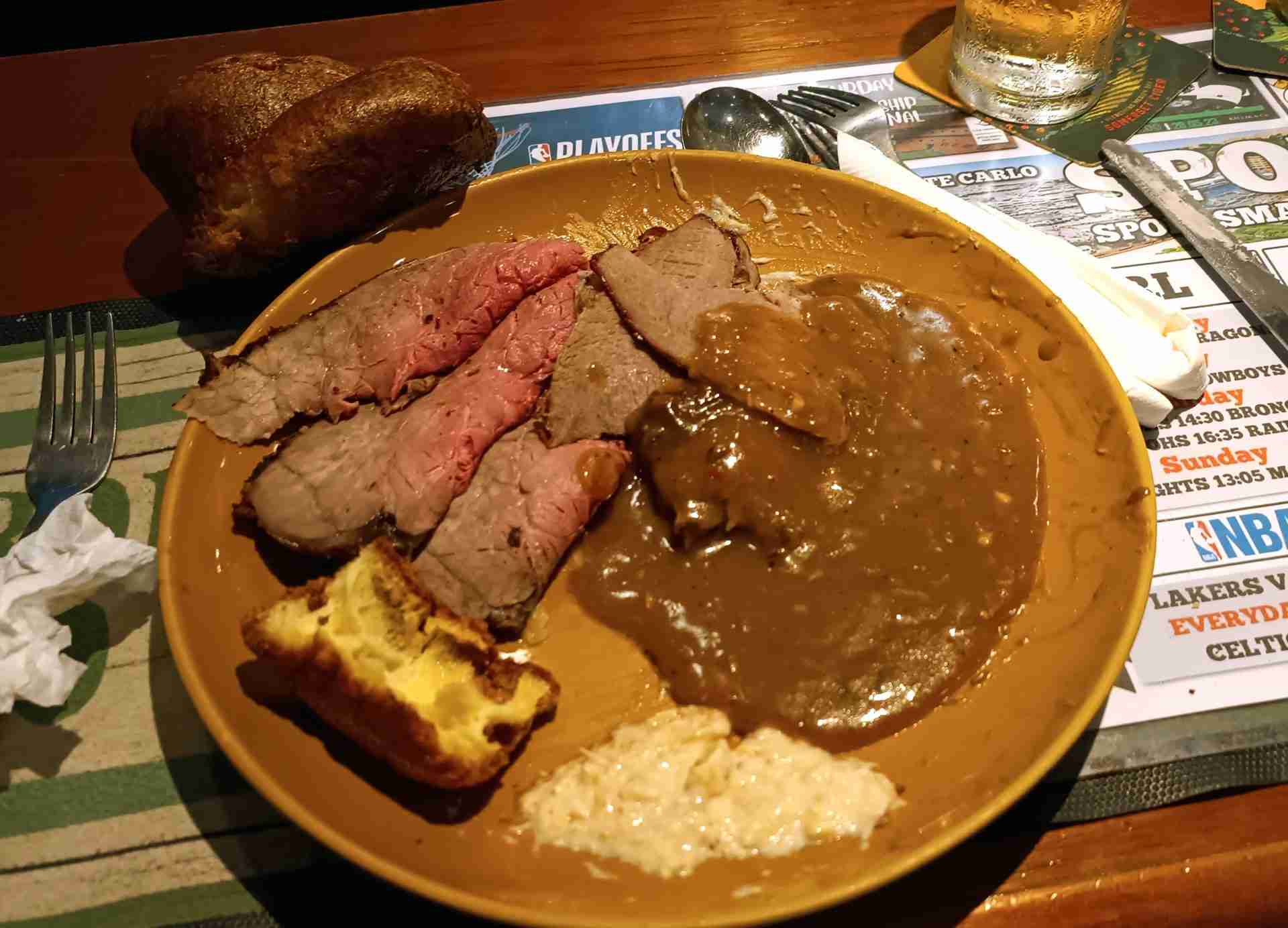
Food Photos Restaurant Version
Well, since I already revealed my McDonald’s meal in the video above, how about stay with the restaurant theme?
There’s a place on Soi 13 between the beach and “2nd Road” (it was called that in the 80’s when I visited here often, still is).
The Sportsman. Really nice British style sports-pub. On Sundays, they have their carvery buffet. Go back as much as you like, eat your fill, and then dessert is included. Protein load-up extravaganza for the equivalent of about $11.30 USD.
This was after a 27-hour washout period (fast), which I elaborate upon in the member’s portion of the foregoing section. I’ve got new stuff and a new way of thinking about fasting altogether (makes it easier and, for me, more successful…better results and better keeping to a regimen…what’s that worth?)


See you Thursday for some Hit & Run style, Jots & Tittles.
WHAT IT'S ABOUT AND HOW IT WORKS
Free The Animal is an eclectic writing project about everything since November 2003. 23 years, 5,500 posts, 5 million words.
It's a paid membership blog. Most posts are free and public, but only paid members can comment. What determines whether it's free or paid is when I publish. Monday through Friday, free and public. Saturday and Sunday, for paid members. That's it. Membership info here.
The Great Awakenings theory is interesting but according to The Fourth Turning analysis the prior awakenings would have started around 20 years after a major crisis (ie. 1960’s), being driven by the children born post-crisis (ie. baby boomers) rebelling against the order established by the previous generations who resolved the crisis. The current insanity seems less like an Awakening and more similar to whatever was going on with the flappers, the previous exemplars of androgynous and seemingly purposeful ugliness, except multiplied by 10 on this turn round the widening gyre.
Yea, personally, I’m never one to apply hindsight references like that to future events.
If someone could reference articles leading up to one of these “Awakenings,” saying hey, we’re going into another one…I might take it more seriously.
These, to me, seems more like ways to categorize them after the fact, like analyzing a football game on Monday morning, then characterizing it as one of THESE kind of games. But that wasn’t apparent before or during the game.
Also, I keep remembering a book I read by Leonard Peikoff like 30 years ago, “Ominous Parallels,” recounting the debauchery of Wiemar Germany as akin to the slide down to sewer level the West has been engaged in since the 1960s.
… I was just watching John Wick 4 last night; he’s in Germany and such utter depravity was well on display in nightclubs.
It’s weird. Such insecure people, if you can call them that.