
Dry Fasting Round 2
Getting on the same page about dietary and fasting philosophy and practicality
I’ve been at this blogging gig for 21 years, anniversary just a couple of weeks out—November 2003. In terms of the diet, health, and fitness, that goes back to May 2007. That was 17 1/2 years ago. Wanna check out my very first post on the topic? How about [water] fasting? December 2007, first post, just shy of 17 years ago.
I’ve conducted two 30-hr fasts so far, in both cases lunch being the final meal until dinner the following day, two hours after a strenuous weight-lifting workout. Interestingly, the toughest part of the fast was the first evening when my body was expecting dinner. The first fast, I actually went to bed early just in hopes of escaping the excruciating, almost nauseating hunger, which in itself ought to be a clue that your body needs a bit of whipping into shape. In both fasts I got to sleep quickly, slept wonderfully, and woke up refreshed and not hungry at all. The hunger returned mid-morning but was quite subdued and I found it no problem to put in a workout and then wait an additional hour or so before dinner. Over hundreds of thousands of years of evolution, it has only been the last 10,000 years where some people have had the opportunity to never be truly hungry. In short, we are designed to go significant periods of time without intake, and even to expend significant energy (like a hunt, a chase) prior to being able to eat. Wild animals exist in this fashion.
That was my ethic (hungry? Then go hunt.) for the next year or two where I used a combination of Paleo (lowish carb), heavy lifting, and doing 2x 30hr fasts per week to drop about 50 pounds.
I got some notoriety, and not just among the plebeians. I had many credentialed folks all over the world reaching out to me. I was invited as a guest on more health podcasts than I can list and got speaking gigs at conferences. My fav speaking gig was at the Ancestral Health Symposium at UCLA in 2011 and then at Harvard Law School in 2012. I was among the very few zero-credentialed speaking on the same stage as the heavyweights.
This is all of record, right here on this blog, and I never do anyone’s homework for them.
Did you read that? I never do anyone’s homework for them.
What that means in practical, “influencer” terms is that I bait people. The credentialed and non-credentialed alike. I’ve been at this a long time in a very specific area and I almost never ever bother to back up what I write today with “studies,” because I have a 17-year history I’m standing on and not just dozens, not just hundreds, but thousands of posts (about 4,000 posts). And under those posts, tens of thousands of comments from real people checking out and trying out what I publish. Self experimentation.
I sit in the catbird’s seat.
Far from causing anguish, I love it when a credentialed person sees what I wrote, assumes that as a non-credentialed, I just woke up this morning and got bright-eyed on a thing.
Oh, cool, I get to make them lose sleep and feel fucktarded and stupid!
… Here’s a thing about human awareness that’s weird, and it happens to us all. There are so many things we never take notice of, then one day we take notice of something that has always been there. And then we begin noticing it all the time.
I force that.
So when a credentialed person rings in and makes all the usual assumptions, what has happened is that he or she is now aware of me, what I’m asserting (with or without credentialed references), or both, and now they’ve been tuned to notice that thing.
Months or years hence, they ring in: “you were right all along.”
This is my game: make people lose sleep and, eventually, feel stupid.
It’s the core theme of my testimonials here. “I thought you were an idiot, but you were right.”
To recap, I do not give a fuck about your credentials and to the extent that you tout them over and over, it signals to me that you are lazy and dishonest.
… But when a credentialed person rings in over something little layman me wrote over the last 17 years, y’know what I immediately know?
- I’ve hit a cord.
- He doesn’t like it one little bit.
Advantage me.
Onward…
I want to distill all the fucking noise. The noise comes from various diet and fasting advocates alike.
Did you notice that I made a critical distinction, there? There is diet (energy intake) and fast (no energy intake). What’s the best way to think about that distinction? I made you another “world-famous” simple-chart.
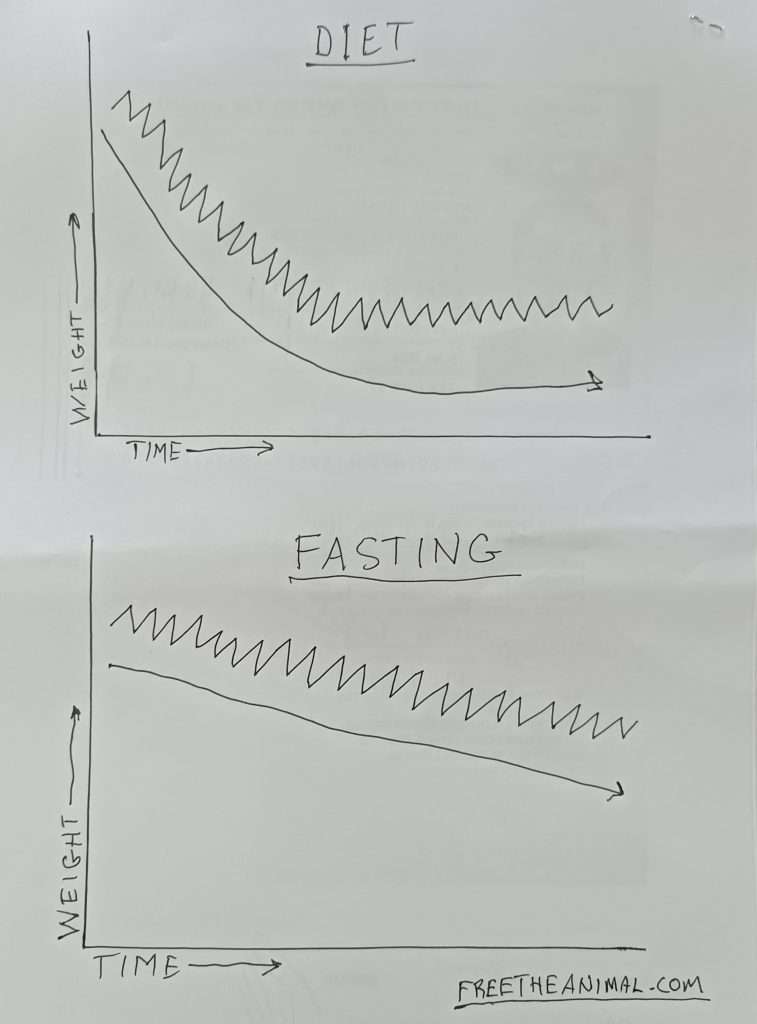
If you are on a (whatever) weight/fat loss diet, you will almost certainly have initial success and, for what are a myriad of reasons, your loss will stall and unless lucky (or disciplined), you’ll regain (often, with interest).
This phenomenon is very good for business!
Fasting makes a difference, and it’s why it’s awful for business. You eat fuckall. Yea, that’s what you eat. Fuckall.
Brad Pilon, in his old fasting book Eat Stop Eat, changed my thinking with one simple realization all those 17 years ago:
“What do I need to eat to lose weight?”
That distills the difference between a diet and fasting in a short sentence.
Fasting eliminates that crucial variable: energy.
All you need to do is determine how long of no energy to lose the weight, and then how long, on average, to maintain the new you.
You also need to determine what regime is good for you. Does it mater what I like? Why should it? Ultimately, it’s about what works and what you like.
I hate both alternate-day fasting and eating-window fasting. For me, it makes life fucking miserable and cut off from social stuff. As though I want to live longer being bored and miserable.
I like balls-ass fasting (30hr min) and then eat whatever the fuck I want, when I want.
… What DRY fasting does is give you a 2-3x efficiency edge.
This is not controversial, unless you’re an obese biochemist who doesn’t like what I’ve been posting because his Thai gal can’t wrap her arms around his protruded belly I digress…
I’ll give you a brief explanation in narrative form. You’re welcome to Google around, search YouTube, search forums, etc. Since about 2017-ish, dry fasting became a thing and there are not only MDs and other health professionals using it clinically (Russian MDs since 1993), but thousands of people self-experimenting and reporting their results which, taken as average, line up with expectations.
Here goes…
When you lose weight, you’re shedding body mass. That mass is a mix of water, fat, and lean tissue. But losing weight boils down to consuming less energy—eating or drinking less energy over time than you expend energy. It’s all about energy balance, and it’s inviolable. There are myriad factors at play in how your body handles an energy deficit, but what you ultimately lose is some combination of water, fat, and lean tissue.
Initially, when you’re in a significant energy deficit over time, your weight loss is chaotic. The first few days, it’s mostly water weight, courtesy of glycogen depletion. Glycogen, your stored form of carbs in muscles and liver, binds water. So when glycogen goes, it takes water with it. There might be a smidge of lean mass catabolism to meet your brain’s glucose demands, but it’s negligible.
Once you move past the glycogen depletion stage, it’s clearer that you’re shedding fat, with only a minor hit to lean mass. Short-term, this lean mass loss is insignificant—nothing to lose sleep over. Our bodies are programmed to tap into fat reserves. Especially when fasting.
If you’re taking in zero energy and just water, that’s a wet fast. But dry fasting, where you consume no water, is a whole different beast. Your body not only burns fat for energy, but it also makes water from it. Most stored fat is saturated and loaded with hydrogen atoms, which release and form water as you breathe in oxygen (H2O).
There’s a treasure trove of anecdotes online—people sharing their dry fasting journeys. I’ve done hundreds of fasts with water or zero-calorie drinks like unsweetened coffee or tea. But dry fasting? It’s a game-changer. One day of dry fasting can be twice as effective as wet fasting, and over several days, say 3 to 5, it’s about three times more efficient.
Why? Because without water, your body is forced to metabolize more fat—not just for energy, but to make water. The kicker? When you end the fast, some weight comes back as you replenish glycogen in muscles and liver, which requires water. Any lean mass loss is easily fixed with some gym time and protein.
What won’t come back, though, is the extra fat you burned to make that water during the fast. To regain that fat, you’d have to overeat [again] consistently. So, dry fasting acts as a buffer against rebound weight gain—where you pack on all the weight you lost, plus more.
… Now for an insiders update as to what I’ve been up to personally in this newest journey.
WHAT IT'S ABOUT AND HOW IT WORKS
Free The Animal is an eclectic writing project about everything since November 2003. 23 years, 5,500 posts, 5 million words.
It's a paid membership blog. Most posts are free and public, but only paid members can comment. What determines whether it's free or paid is when I publish. Monday through Friday, free and public. Saturday and Sunday, for paid members. That's it. Membership info here.