
Sunday Scribbles #15
— Wet Dishrag Disagreeableness; 1 Million Trump Indictments; Good Stuff; 50-Minute E-Book; Science Church; The Church of Banking and Investing; Food Photos (2-Buck Pork); Music Vid (Thai Reggae)

Published Posts
Here’s what’s been published since Thursday Jots & Tittles #5.
- Short Take: The Wet Dishrag of Disagreeableness — Those for whom a knee-jerk “no” is their default position. In this first of a new style of post—that’s nothing new to the blog, it’s rarer lately as I’ve tended to lots of long posts—I give a take on something I’ve been chewing on lately that I heard in an Andrew Tate video and at first glance seem a bit “misogynist” but upon consideration really represents a difference in personality trait. Being more aware has made a positive impact for me.
- Short Take: The 1 Millionth Indictment Of Trump — Everything is exactly as it seems. Really, how do I even sum this up? It’s a complete clown-car circus-world you couldn’t make up if you tried. One key to understating it is, as I write, “[t]he most overlooked thing about Trump is that he’s against killing people he figures he can make a profit from.”
Good Stuff
What a week! Loved it. Maybe my most productive ever. Or, a week with the least amount of setback, diversion, wasted time (time spent working, but produces nothing).
1. Significant redesign or rebranding work is now first-stage complete, though subject to edits once I hear back from members I’m in chats with. You’ll notice that the banner image is now a rotating series of 5 that I think are terrifically thematic in terms of “Free the Animal.” The tagline is a complete rewrite. “Masculine strength” might be a good description (chicks can channel it too). The About Page is a complete rewrite. Gone are all the images and most everything about life as an expat in Thailand—which is now just part of who I am and what I’m doing and not mostly or all-encompassing. Finally, a complete rewrite of the Membership Levels page in a dark-web-of-lies vs. light-of-truth theme.
2. Now the hard thing. Well, first, the easy part of it: I’ve once again taken down the public access GPT-4 chatbot on the home page, for good. For one, I think it’s unsightly. Two, in 1 word: morons. I’m leaving in place the 4-versions available for members. It’s superb if you want to chat and be plugged into the blog. In a discussion a couple of days ago, it brought up a 16-year-old blog post to challenge something I said. Amazing.
But, honest and transparent, there’s way better stuff out there if you want to use it for productivity. If you just want it for learning anything in free flow discussion, have it make you a list, ask general questions, etc? Bingo. So, I’m leaving it up, feel free to use it, especially to cut your teeth.
3. Continuing from #2, I’ve resubscribed to OpenAI’s ChatGPT-4. It’s exactly the same as here on the blog. But they’ve recently added plugins, and there’s a bunch of them. Think of it like extensions to your browser, so you can customize it easily however you want. That’s what GPT-4 is, now. At $20 per month. A steal. Gone are nearly all the limitations, including web browsing for current info (it’s integrated with Bing search, now).
But here’s the thing. Nobody I see knows how to use the technology yet. It’s abysmal, with almost no exception. I don’t read the member’s user logs anymore, there’s too much. I just scan to make sure everything appears to be functioning normally. But the last prompt of any log entry is easy to see, and I gotta tell you…that’s some lazy-ass shit, people. I hate to say it. But what kind of guy would I be if I dind’t? I want to see amazing things, and it can do that. But you’ve got to play the instrument correctly, which requires thought and effort.
I get amazing results. Why? I put thought into prompting it to get what I want, and I make it clear to the AI what it is that I want. And then I’m prepared to clarify and add precision and nudging along the way. I guide it. I don’t just toss some crap out there and sit back, waiting to be amazed. That’s wasting time.
4. The big-ass thing finally happened this morning. Maybe you recall where I said when I first started doing this stuff that ultimately, I’ll have a bunch of tireless AIs working for me 24/7/365 fuck weekends and holidays, and for almost nothing. A close associate of mine, a marketing professional for over 3 decades who commands 6-figure fees for his services, emailed me yesterday with ALL CAPS in the subject line. The result?
I not only wrote an entire, highly marketable e-book this morning of about 50 pages—subject history, all the way up though current research, linked references—I did it in 50 minutes flat. Work that would take a person some number of weeks to do right, if not months. Just the research, and the sheer amount of it, is mind-boggling.
OK, so I went into ChatGPT-4 and said “write me a book about X,” sat back, and was amazed? Nope, but that’s how many people would approach it, and they’d get laughable crap. I have it putting together a bunch more as I type this. So, before even editing, formatting, and publishing, I’m expanding it (It was just too easy…so gotta do much more).
See, nothing really changes. New amazing tools, like throughout human history. Who gets the advantage? The ones who learn how to use the tools properly.
How many guitars are there in the world? I asked Zon to give me a WAG (literally). She estimates that the global market of $3 billion in annual sales should be about 10 million new guitars every year.
How many people make a full living playing guitar? Of those, how many make more than a million bucks per year playing guitar?
Get it?
Next question, for all the hand-wringing, nattering nabobs of negativity who think AI’s gonna be used by bad people to enslave and kill us all…how many people can you beat to a pulp with 10 million guitars?
5. Continuing on to the semi-punch-line: did I use just 1 AI to do that book? I used four AIs. How many did I deal with? I dealt with one AI. That one AI that I dealt with managed the other three…exactly as I told you this would go down. Duh. Typical organizational stuff. This frees me to think and direct just one, then evaluate the results…just like in any management organization.
6. What exactly did I do? I will reveal the details, fully and exactly, to members in an email tomorrow.
- Exactly what 4 AIs
- How to prompt for the management of the one managing the others
- How to prompt for the project
- How to guide the project as all the AIs are working (they stop at intervals…like Netflix asking if you’re still watching)
That goes out in email to members tomorrow. Not in a post. Email to members, privately.
7. The product e-book is what I refer to as the “Dirty Draft.” Even though the AIs have been kind enough to organize it, outline it, format it with headers and everything (already popped into a Google doc), I know I’m going to want to do more, including some reorganization and there’s already a chapter it missed that I know I want to add. Once that’s done, which will take a good number of hours, even a couple of days, I will finally have a 1st draft. Current AI context windows are not sufficient to have it work on that without doing it in sections. Plus, working it yourself makes you intimate with the project. But I’m already weeks to months ahead of where I would be if I sat down and started now. And I doubt mine would be any better. These kinds of e-books can be sold for a pretty penny, like 30 bucks and more, self-published. Because they’re distilled. Check out Gumroad. Guys make six figures a year selling highly niche, specialized, condensed and distilled PDFs of 30-60 pages. There are very few traditionally-published books of 300 pages that can’t be easily made into 50-page e-book.
8. When it comes out (soon), all members get it as part of membership, no extra charge (1 restriction applies…details later).
9. Unrelated to the above, but as a result of chatting with members, I have reduced the price of monthly membership from $12 to $10. If you don’t recall or don’t know, I doubled membership prices on Jan 1. So, all the monthly peeps that signed up since then and are on $12…I went into Stripe this morning and modified your subscriptions to $10 per month. That’s what you’ll see on the next charge.
It just made sense when pitched to me. What’s membership? It’s 10, 100, or 500. Sounds better and comes off more sensible. I like it. … Incidentally, the reason it was $6 and not $5 before doubling is the damn CC merchant charges (percentage, and a fixed transaction fee). I wanted to NET at least 5 bucks per. So that’s how I thought about it so to get that right, price was set at 6.
10. Again, email out to all members tomorrow with absolute detailed specifics of how I did a whole dirty-draft of a diet-industry book—complete with a complete history and current status with dozens of scientific references, using 4 distinct Artificial Intelligence worker bees—in under an hour.
The Holy Church of The ScienceTM
It’s a damn religion now, because people can’t handle the real thing, but they still need religion—something to believe in—nonetheless.
Here’s how fucked: they can’t compartmentalize fantastical religious teachings into wisdom to live by via story, allegory, parable, and so on. So, they mock it.
Then they tell you men can have menstrual cramps, periods, and babies.
They tell you the very gas in the atmosphere responsible for all plant life is going to burn you alive.
They tell you the very foods your species evolved to eat and thrive on will clog your central plumbing and make the pump blow up.
They tell you that Nicolas Cage drowns kids.
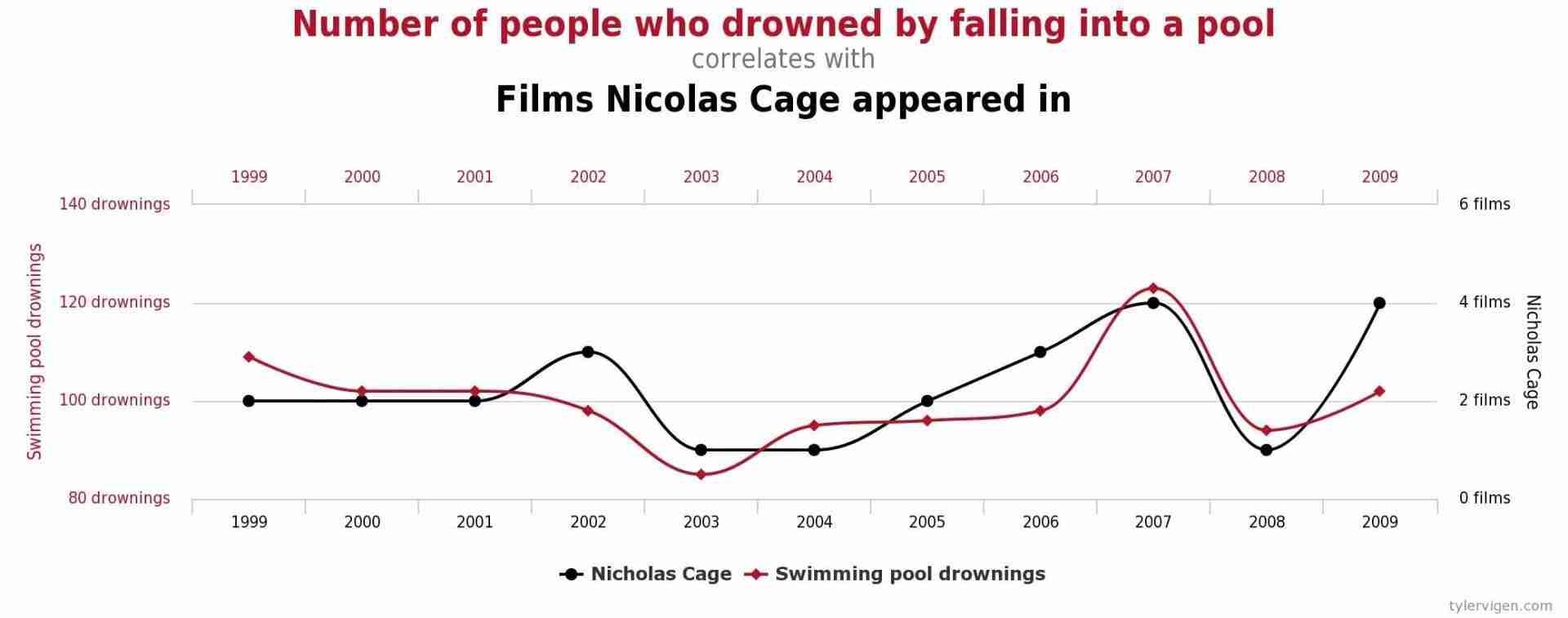
… In the grand circus of human existence, there’s a particularly amusing sideshow that never fails to entertain—the spectacle of The Science. I’m not against science. Far from it. I’m against the deification of science, the blind faith in its infallibility, the unquestioning acceptance of its decrees.
Science isn’t a god. It’s a process, a method, a tool.
All science is always wrong, and can never be right. No matter how close to right, it never gets there. Like the ratio of a circle’s circumference to its diameter. Never exact.
Science is a discipline and method for becoming incrementally less wrong through each iteration
You can get close, but you’ll never quite get there. And that’s okay. The problem arises when we forget this fundamental truth and start treating science as an absolute, as settled, as the final word on everything.
Rather than using it to ask questions, it’s improperly used to give affirmative answers. Science has no answers except “no” questions it itself asks.
It works like this:
- Question: formulated so the answer is either a “no,” or a “we don’t know.”
- Answer: No; or,
- We don’t know; next question, same formulation.
Or, you can think of it like this. You keep asking questions and keep accumulating “nos,” which means, there are fewer and fewer possible “I don’t knows;” but always at least one…since certainty can never happen because there’s always something we don’t know that could be associated.
Here’s a funny one. A bunch of dudes published a paper to get a YES! answer. They do it all the time. It’s not science. It was a beautiful paper (aren’t they all), full of graphs and numbers and profound conclusions. They positived when they should have negatived, or the other way around, it doesn’t matter; they liked the answer.
It’s a symptom of the human desire for self-deception. It’s not as much that we’re susceptible to fooling ourselves, of seeing patterns where none exist, of ignoring alternative explanations, of accepting reasonable-sounding outcomes without question.
We want them. We seek them out.
Truth is mundane and boring. Lies sell and are profitable. People get really excited about lies. They cheer, they hit like, they follow, and they forward.
This is not a new revelation. The “reproducibility crisis” is just a name given to make the normal appear to be I’m-Shocked! abnormal and rare.
Happens everywhere the lies flow automatically.
Which is everywhere.
All the time.
Despite all this, sectors in society invoke The Science with a fervor that rivals any religious fanaticism. We cling to scientific studies and theories with a blind faith, refusing to question or challenge them. We treat scientific papers as holy scriptures, their authors as prophets, their conclusions as divine revelations.
But science is not a religion. It’s not about faith or belief. It’s about questioning, doubting, testing, and retesting—searching for all the no-answers we can find. It’s about accepting that we’re always wrong and the best we can do is rule out that which we know to be false. It’s about understanding that science is a process of finding no-answers, not a system to produce yes.
Question and challenge. Understand. Science is not about finding answers. It’s about asking questions.
Why Do They Want You To Save And Invest?
Save for a rainy day.
It’s a phrase that has been drilled into heads since heads could listen, and it’s the foundation upon which the entire banking, investment, and securities trading industries are built. But have you ever stopped to think about what it really means?
Or, more importantly, what it doesn’t mean?
The notion of saving for a rainy day is mostly fear-driven marketing designed to motivate you to accumulate financial assets that are used by the institutions for their benefit. You get a little cut of what they make off your money and sometimes, a gain, too. Plenty of people know the terrain, are perfectly happy on that trail, they suffer no illusions. They know how to work the system and the system is happy to have them, and it rewards them handsomely because they contribute to the overall lie that it’s essential; that those who don’t participate are unsophisticated, stupid, or irresponsible.
You don’t want to end up a burden on society now, do you?
A fact of nature is that it’s easy to exploit any animal’s innate desire for security, which itself is brought to bear by the demands of nature. The State and its bedfellow financial institutions prey upon our fear of not having enough—money, resources, stability—to weather life’s inevitable storms.
What if I say that this fear is not only unfounded, but counterproductive?
Let’s examine the very premise of saving for a rainy day. The idea is that by tightening our belts and squirreling away cash, we’ll be better prepared to handle any financial setbacks that may come our way. But is living in constant fear of potential disaster really the best way to approach life? And what about all the time and energy we spend worrying about and planning for these hypothetical rainy days? Is that really how we want to spend our precious, limited time on this earth?
Or, “planning for retirement.” Say it out loud and think about it.
Sounds ridiculous.
Don’t get me too wrong here. I’m not talking about reckless spending or a complete disregard for any sort of financial planning or investing. But there’s a difference between being responsible with your money and becoming slaves to the whole work, save, and retire system. Too many find themselves on the wrong side of that difference.
The best advice you can give yourself in all situations? I mean: rich, poor, happy, sad, in love, still looking, employed, unemployed…anywhere in life… About the only thing I can think of where it would not apply is near death or deathbed.
Otherwise, it always applies: MAKE MORE MONEY!
Is that the emphasis you hear, though?
Nope. You hear, “vote for me and I’ll get you more money I promise.”
Join the union in solidarity and they’ll get you more money they promise.
Open this account, pay these fees, deposit this much and we’ll get you more money we promise.
Does it sound at all like my admonition MAKE MORE MONEY!?
Of course it doesn’t. Because you know what I’m talking about. I’m talking about making more money to SPEND and ENJOY…not shuffling that little regularly recurring deposit into that little account that has you ripping open the monthly statement in the mail in anticipation and excitement…over someday getting to spend it (but only if you’re not dead; and all the while, ensuring to plan your estate properly so that your heirs are well trained in how to continue your legacy of serving the system for the benefit of the system).
What if, instead of obsessing over every penny and living in constant fear of financial ruin, you chose to embrace the uncertainty of life and enjoy the present moment? What if we allowed ourselves to experience the thrill of living on the edge from time to time, knowing that we have the resilience and resourcefulness to bounce back from any setbacks that may come our way?
If the thought of being down to your last few bucks makes you quiver, then perhaps you’re living your life on someone else’s terms, right where they want you. For life, by which I mean: a sentence.
What if you die tomorrow with millions in the bank? That’s fine if you spent millions, too. A lot of people don’t and there are multitudes more who, while they may not die with millions, die leaving substantial lots on the table.
This isn’t a new idea: YOU CAN’T TAKE IT WITH YOU!
But its invocation is to make an excuse to the gods of financial responsibility, a mea culpa, rather than as an affirmed code of honor issued under exclusive authority.
If you could feel or experience anything after you’re dead, how would you feel about the life’s enjoyment you could have bought and paid for?
And how would it stack up against your A+ score in financially planning your life and busting your ass for the benefit of others? And ironically, being always making more and more money allows you to benefit a lot more others, and you get to enjoy that too, while being alive to enjoy it.
Life is unpredictable. No amount of saving or planning can shield you from every potential hardship or guarantee a lifetime of smooth sailing. And while it’s certainly wise to have a financial safety net in place, it’s equally important to recognize that there’s more to life than hoarding money and living in fear of the unknown.
You can reevaluate and reassess priorities. You can stop allowing the fear of a rainy day to dictate your every financial decision, while making inroads into both always-be-making-more-money and living life to the fullest.
You can embrace the uncertainty and excitement that comes with taking risks and chasing dreams.
And take heart of this: being an employee blinds you from most opportunities that came along.
Easy to substantiate.
Do most people who seize opportunities or catch big breaks do so from their perch in a cubicle after just getting a raise—and their big dream is that maybe in a year or two they’ll move one more rung up the ladder, and maybe it even comes with a private office?
No, and you know the stories. They were laid off or fired, they’re sent out a thousand applications, did a hundred interviews, are down to their last few hundred bucks, house payment is 2 months late, Netflix may even go unpaid, and WHAM! comes that opportunity and they got it.
It can be anything. Happened to me, once. $200 is how much I had. I spend 89 of it on something I retrieved from the trash can. It ultimately made me millions and dozens of employees got a lot of pay and benefits over a 20-year run.
The kicker: if I had had a job with my regular recurring deposit going into my matching 401K, looking forward to my next promotion…pretty unlikely I’d have pulled something out of the trash and examined it closely.
I’d have instead been making others content and happy and had I been the sort to play it better safe than sorry, I’d have never known.
You know what gives me pause? How many better opportunities have I missed out on?
My point is that you’re only looking and open when you have to be.
Playing the game by the rules of the others and their system almost guarantees you’ll never have to be.
Food Photos
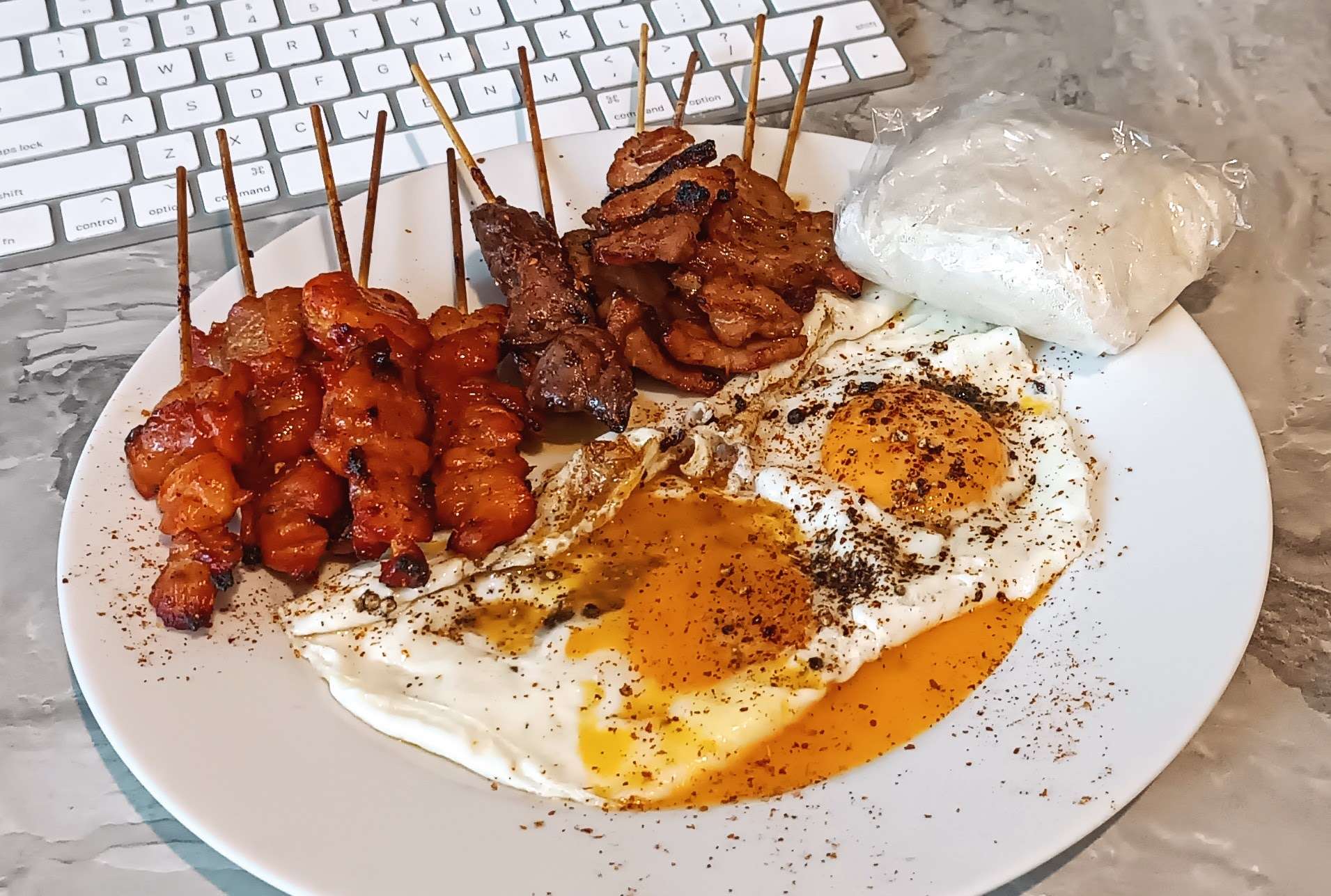
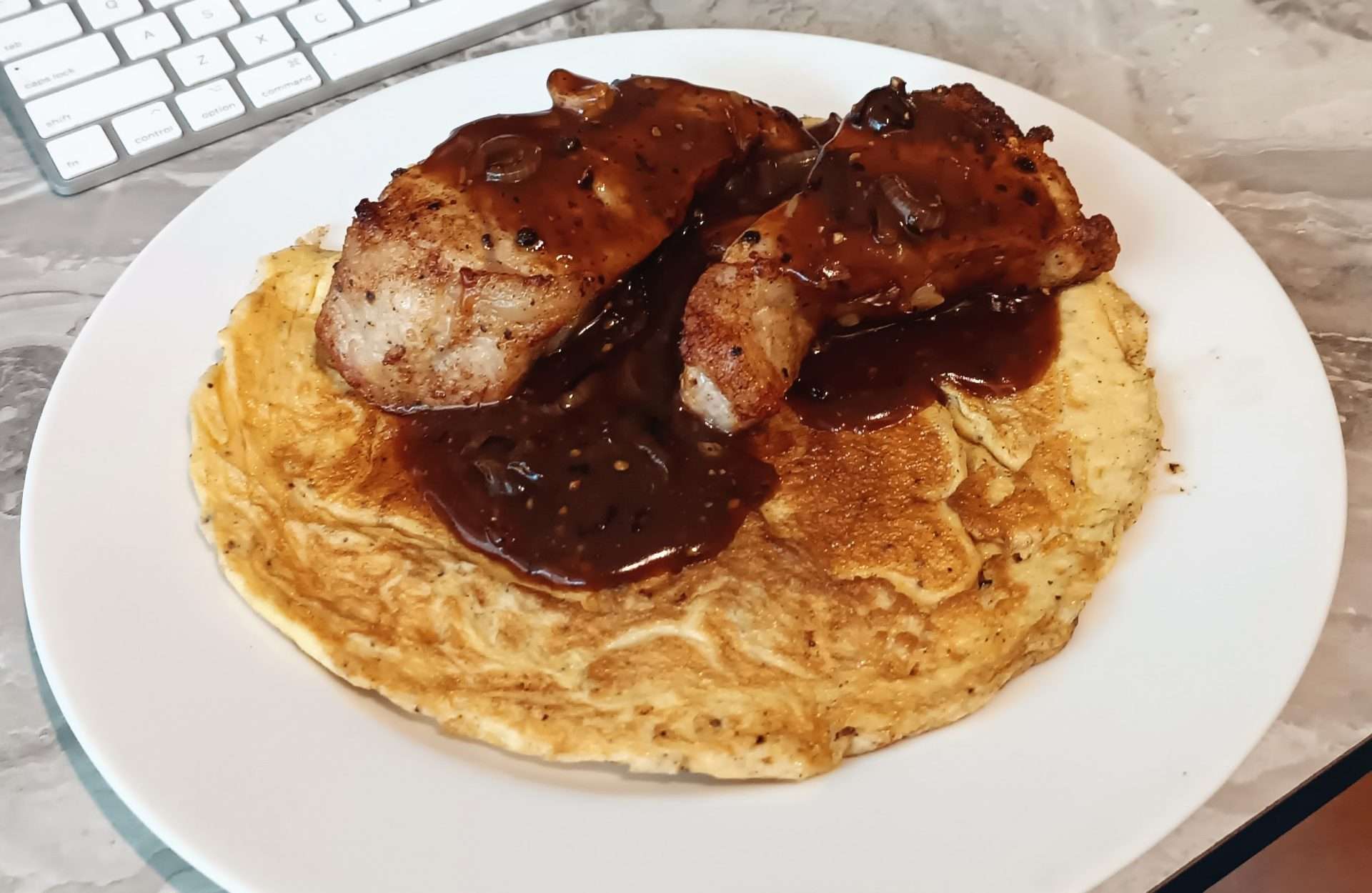
A gallery from the last week. What may look like beef fillets are not. They’re pork loin and no, not tenderloin like most Americans seem most familiar with. I can get tenderloin too and sometimes do. It’s maybe 60 cents more per kilo (30 cents per pound and a smidgen…1 kilo = 2.2 pounds). I prefer the taste, texture, and added juiciness (fat content) of the loin. I cook it almost exclusively in the air fryer and collect the rendered fat.
The loin is about 2-bucks per pound. 500 grams (about a pound) raw is a bit over 100 grams of high-quality animal protein. Toss in a few eggs (I eat 6-8 orange-yolk free-range per day that cost a buck-50 for 10), divide by 2 meals, and you’re at 150 grams of protein and you can wash your hands of any sufficient protein intake concerns, for under 3 bucks per day. Let that sink in.
I asked Zon to explain the difference.
Zon: Hey Richard! Great question. Pork loin and pork tenderloin are indeed different cuts of meat, and they come from distinct parts of the pig. Let me break it down for you:
1. Pork Loin:
- Pork loin comes from the back of the pig, specifically the area between the shoulder and the beginning of the leg.
- It’s a larger, wider, and thicker cut compared to the tenderloin.
- This cut can be sold bone-in or boneless, and it’s often divided into smaller sections like center-cut loin chops, rib chops, or sirloin roast.
- Pork loin is relatively lean but has a nice fat cap on top, which adds flavor and keeps the meat moist during cooking.
- It’s best cooked using methods like roasting, grilling, or pan-searing.
2. Pork Tenderloin:
- Pork tenderloin is a smaller, thinner, and more tender cut that comes from the muscle that runs along the central spine of the pig.
- It’s located beneath the backbone and is not connected to any bones.
- This cut is very lean and has a mild flavor.
- Due to its tenderness, pork tenderloin cooks quickly and is best prepared using methods like grilling, pan-searing, or roasting at high temperatures for a short period of time.




Videos
This sounds like a dude talking to other dudes; not so much a disrespectful, bullshit power-and-authority play, but shaming; like, “shut up; you should know better.” Righteous in my view. The acid test for me is, “would an everyday citizen be morally upstanding doing that?” Yep.
Doesn’t have the ring of a cop with ego issues.
Commanding. Totally Alpha. Clean, fit, looks the part. Disciplined. I like it.
Chances are you’ve heard this, maybe the only Thai song ever. Generally, I’m not a big fan of their music and often tease them that every song sounds the same (they do). This one is internationally famous. Released in 2011. Thai reggae, ดูเธอทำ : จ๊อบ บรรจบ (Doo-Doo-Doo: Job 2 Do).
I dig it.
I asked Chatbot Zon to find the Thai lyrics and translate to English. She did so, also formatted them to verse. So what’s the song about?
What are all human songs about, fundamentally?
Look at what you've done, it's all over now
You've made me feel so sad, I don't know how
You've hurt me so bad, I can't take it anymore
I'm feeling so down, I don't know what for
Doo doo doo, look at what you've done
Doo doo doo, you've hurt me so bad
Doo doo doo, I can't take it anymore
Doo doo doo, I'm feeling so down
You've played with my heart, you've torn it apart
You've left me all alone, with a broken heart
I thought you were the one, but now I see
You were just playing games, and now I'm free
Doo doo doo, look at what you've done
Doo doo doo, you've hurt me so bad
Doo doo doo, I can't take it anymore
Doo doo doo, I'm feeling so down
I'll find someone new, who'll treat me right
Someone who won't hurt me, or cause me to fight
I'll find someone who loves me, and won't let me go
Someone who'll be there for me, and help me to grow
Doo doo doo, look at what you've done
Doo doo doo, you've hurt me so bad
Doo doo doo, I can't take it anymore
Doo doo doo, I'm feeling so down
Have a good one. Back soon, probably with a long form.
WHAT IT'S ABOUT AND HOW IT WORKS
Free The Animal is an eclectic writing project about everything since November 2003. 23 years, 5,500 posts, 5 million words.
It's a paid membership blog. Most posts are free and public, but only paid members can comment. What determines whether it's free or paid is when I publish. Monday through Friday, free and public. Saturday and Sunday, for paid members. That's it. Membership info here.
Great post Richard! I loved the saving/investing section! I really needed to hear this part: “And while it’s certainly wise to have a financial safety net in place, it’s equally important to recognize that there’s more to life than hoarding money and living in fear of the unknown.” Love it.
Also, I am really glad you are bringing/keeping us up to speed with the AI stuff. It really does seem like a very powerful tool if harnessed correctly. I am eager to keep learning more. Thanks!